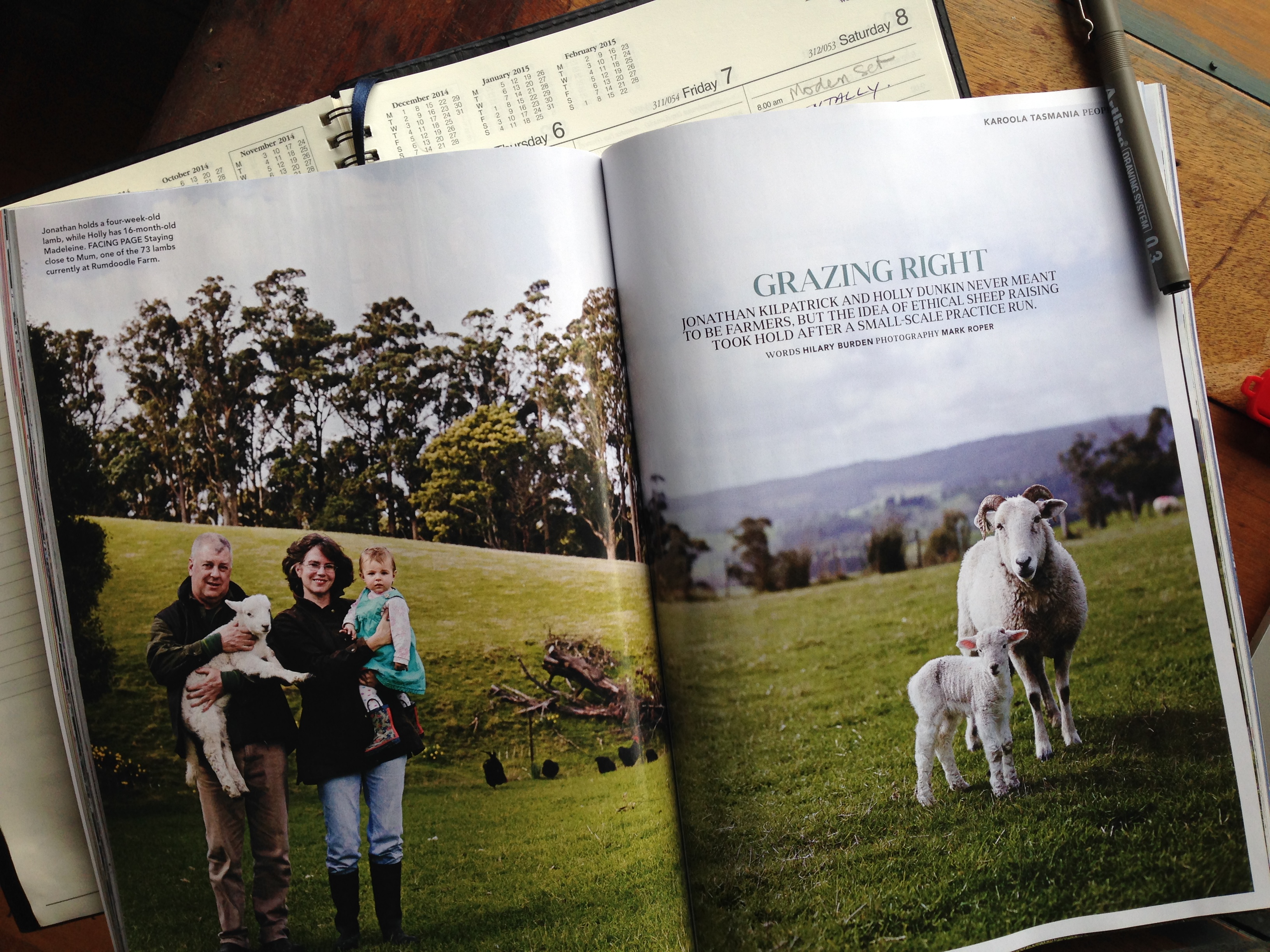
When I first met Holly she was helping out running the Lilydale Market. It was her job to collect the stall fees from us each Sunday as we set up our display of fruit and veg for the day. A few years on and she and her partner Jonathan have welcomed Madeleine into the world and started their own farm, Rumdoodle, which I can see across the paddocks and up the valley from The Nuns’ House. It wasn’t far to go to interview them for Country Style, and I could catch Holly in her lunch hour while Madeleine entertained us pulling video games out of the bookcase.
I love seeing how lives grow by going with the flow.
“We started with five ewes and a ram simply because we had a couple of acres,” says Holly. Now they have 3 rams, 94 ewes, 23 wethers and 73 lambs, plus a flock of Australorp hens – on 20 hectares.
Jonathan’s love of country, I think, is key to living here:
“I really love the fact that I can wake up in the morning when I’m working on the farm, I’m doing things I like doing, and no one is telling me what to do,” says Jonathan. “It gives me an inner peace that I am toiling away and I can see what I’m doing and why I’m doing it – it’s small-scale achievement.”
You can read more of my story on Karoola’s Rumdoodle farmers in the December issue of Country Style magazine – on sale in Australia this week.
I met a lady nearly twice my age today. I use the word ‘lady’ because to me ‘woman’ seems not kind enough, cold as fish, and certainly too small a word. Like calling vintage Champagne “fizz”.
It was the opposite way when I was younger and working for ballsy women’s magazines like British Cosmopolitan. We thought the word ‘lady’ patronizing and demeaning and corrected anyone, especially men, if ever they were to use it. Now I think there might be far more important matters to care more about than the singling out of one word. That’s what age can do for you. Helps you see more horizons than just today’s, more days than just your own.
Jean, for example, has lived longer than anyone I know who still lives at home and looks after herself. Meeting her has made me contemplate that while life is short it’s also long and even though you think you might be old at 50 you might still have half a life to live.
So what are you going to do with it? What good will you do with each extra day? Questions that prick more deeply when you consider The Atlantic’s October cover feature by Gregg Easterbrook, “What Happens When We All Live To 100?” In it he writes that every year, the newly born live about three months longer than those born the previous year, and that one day the elderly will outnumber the recently arrived.
I’m not sure if we can just leave our future to the young. There won’t be enough of them around. We must also worry about how we stay connected when we age, and how age and experience must both influence and count. So, I listened to Jean.
Unlike most cold callers, her voice held a tone that was present, warm and lived in. And, unlike most cold callers, she did not assume we were new best friends. She told me she wanted to see the community of Launceston create a festival of peace, in honour of our late Governor Peter Underwood. He had shown the courage to call for peace during his 2014 Anzac Day address while at the same time warning against the glorification of war.
“All our remembrances and honours are meaningless,” he said, not long before his sad and unexpected passing, “unless we also vow to become resolute about peace.”
I was one of a long and growing list of people Jean was calling. I didn’t know who she was or how I could help but she suggested we meet for coffee. I fought this need to know what Jean did. We hadn’t met professionally or socially, in life or online. I felt I needed context so asked could she send an email but she told me she wouldn’t be able to do that. “You’re busy,” she said, “I’ll wait to hear from you when you have time.” And she hung up.
Something in her voice, our chat, and the feeling in between her words made me contact her a week later. That and the agony of life sometimes… Australia sending troops to war… Terror Australis… My friend Leigh says she doesn’t watch the news anymore. Reads books instead.
How could anyone be too busy to talk about peace, I thought.
Jean’s garden, fronting on to the street, was loved and cared for with thrusting clumps of tulips, hellibores that bowed, and a tree peony exploding with flowers in bud. The door opened on a surprisingly bright face and firm handshake. Jean showed me to her warm sunlit sitting room with sash window onto another more beautiful back yard and left me while she stepped downstairs to the kitchen to make tea. In front of the window, on the table, was a vase of creamy freesias placed just where visitors could smell them. Jean returned with teacups on a tray and a plate of homemade biscuits.
She was 93. She didn’t have a computer but had no time to waste. We talked about solving conflict through non-violent means but if we had picked up that day’s newspapers together it’s not what we would have read. “Don’t get me started…” Jean said, with the emphasis on every word. She placed both hands on the table and leant on them so as to lift herself slightly out of her chair, shifting her weight as if to stand, wrestling with that restless energy that had got her to this point and, in all hope, to next July’s Peace Festival. Yes, Jean, do get started I thought, although it was obvious that she had been doing that all her life.
I told Jean I’d marched for peace ten years ago with a million people in London’s Hyde Park. But now, more than ever, I felt the need to retreat – that there was nothing I could do to effect peace outside my own back yard.
“Retreat is not the answer,” said Jean. “You must engage.”
So, tell me then, how can I help?
“You can see my eyes are failing, and I can’t use my hands that well,” she said.
I told her I could help be her eyes or her hands, or both. As I left she gave me a piece of paper outlining the aims of the Tasmanian Peace Trust. Keep it, she said. It was signed by the Chairperson, Jean Hearn, in 1985.
The Community Festival Creating Peace will be held in Launceston in July, 2015
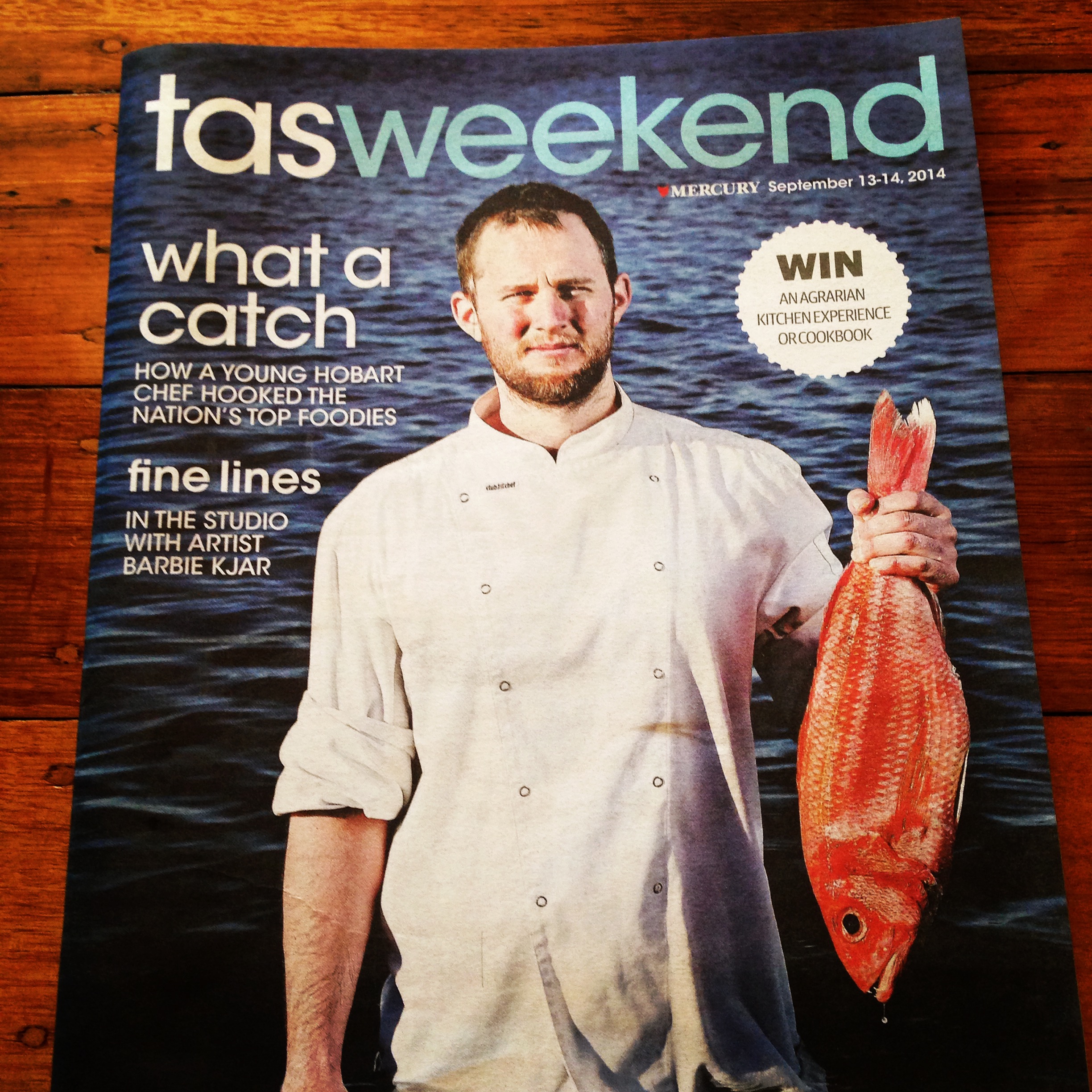
First published in The Mercury, tasweekend, Oct 18-19, 2014
Last weekend the Saturday Mercury magazine took on a brand new look, extra pages, and a good news take on modern Tasmania under the wings of tasweekend editor Amanda Ducker.
“Tasmania is not the centre of the universe,” she wrote in her re-launch editor’s letter, “but it’s at the centre of our lives”. It’s a perspective to watch and enjoy. For this blog’s Tassie followers, I’m happy to add that I’m tasweekend‘s new upfront columnist. I’d love your feedback – and input too. I love a good weekend supplement and it’s exciting to have one made here to reflect how unique an island we are. Love to know what you think when you pick up Saturday’s Mercury.
Launceston is in mourning today. It lost a friend. Rest In Peace Deputy Mayor, Alderman Jeremy Ball, a true guardian of good works. Your support for the Lilydale community is treasured. Remembering you today in this view of Lilydale’s Merthyr Park “For the People – For All Time”. So much promise of spring to come in those creamy blackwood blossoms set to brighten. So much ahead to give. You will be remembered here for all time amid the whispering eucalypts… Thank you Jeremy Ball for your good work, truth and passion.
If you are a short story writer, traveller, blogger, author, journal keeper, memoirist, essayist, or you just love writing about where you live and the places you visit, you might be interested in a writing workshop held at my place.
The ramshackle Nuns’ House, which features as lively as a character in my book A Story of Seven Summers, lies in the peaceful Pipers River Valley – just twenty minutes’ drive from Launceston. With Spring here, the pink paddock will be pink again soon… Meantime, here’s a view of Mt Arthur from a summer verandah:
View of Mt Arthur from the Nuns’ House, Karoola
Workshops are designed to fire up your creativity, help you find your own voice, and develop your writing style in a place that inspires.
Broadly, here are the details:
Three-hour workshops aimed at people who want to write and who love reading.
Workshops are run at 9am or 2pm, however other times, including evenings, could work, too.
Available for groups up to six on request.
Minimum two participants – $75 each ($65 per person for a group booking – maximum 6 people).
Bring pen, notebook or journal, and be prepared for a short country walk (e.g. sturdy shoes & a waterproof jacket – this is Tasmania!).
A choice of B&B accommodation can be arranged in the local area if required.
To make an enquiry please email me, Hilary, at hburden@bigpond.com
Review:
“Landscape and memory, elemental to writing place, are evoked from Day One of Hilary Burden’s workshops. We sit around a sturdy wooden table opposite a mammoth wood heater, looking out Federation windows at the trees and valleys of Karoola, soaked postcard green from an early Spring shower.
Time and place are very present here, the past palpable, and Hilary knows it.
She brings it into our understanding and discovery of how and where to find our sense of place, how to bring it alive on the page, past our uncertainties, our doubts, our defences. She finds her way under them, sidetracks them until we deliver, in four sessions, the stories we carried to her place.
They’re written now, early drafts for some, signposts for others, a meld of landscape and memory, plaited from our lives, woven into story. Marks on the page, marks in time – writing about place.”



 Hilary Burden