The Aboriginal flag flying high next to the Australian Union Jack outside George Town’s Memorial Hall
By the time you read this I will have been inducted into the Port Dalrymple School’s Wall of Pride. I’m pretty chuffed that my old school in George Town cares about writers as much as I care about being one. But I wonder, when I address the school assembly, how the students will take this alumni on the wall, alongside champion cyclist Danny Clark and Hawthorn assistant coach Brendon Bolton.
Although grateful to receive this honor, I would prefer the spotlight shone on them. Awards should not be about setting an individual apart, but about inspiring a community to dream, strive, learn or nurture.
I hope I use this time well and don’t discourage them from a writer’s life. Like most creative pursuits, writing is a vocation, not one that pays well or enables you to buy a house in Sydney in your lifetime. It is also solitary rather than social – unless you make it so. People seem to be writing more these days on social media but it doesn’t mean it’s readable.
My advice to the Port Dalrymple School assembly will be to try and balance social media with how your heart beats in a broader world. Try not to fill your day receiving life through one focal point (be it smart phone, tablet or computer), but to get to know the landscape where you are (night and day) and its kaleidoscope of focal points.
I’ll mention when my father was the local doctor in George Town he asked if I’d like to go to Grammar school and I said no I thought I’d be fine right here. I may mention how this school is where I first read Shakespeare out loud, heard Edith Piaf sing on a record in a French class, learnt to touch type with all fingers, watched the first man walk on the moon on a classroom telly, heard Prime Minister Gough Whitlam had been sacked, and had my first period.
I’ll explain it was through their school I learnt to swim at Lagoon Beach and dance the Can Can (badly) on stage at the Memorial Hall. I’ll tell them I was hopeless at exams but had fantastic teachers I still remember, and that my playlist was vinyl and included Supertramp, Abba and Marcia Hines.
If I have one regret in life it is that a seventies’ education in Tasmania did not include a study of the first peoples – other than from a first settler perspective. We were taught Tasmanian Aborigines died with Truganini.
Now, Port Dalrymple School is aligning its cultural arts program with the Australian Curriculum’s focus on Aboriginal cultural studies and the stolen generation. And a coastal walk through George Town has been developed from the town along the foreshore, respecting Aboriginal middens along the way. As children, how more connected to this place might we have been had we known Aboriginal people once fished where we swam?
I’ll also share with the school assembly how it’s the job of schools to teach but the student’s to learn: to have a passion, if not today, then some day. Feel lit from within and know that learning lasts a lifetime.
I’ll mention since returning to Tasmania a decade ago I’ve been striving to learn as much as I can about the landscape we share. I want to feel that sense of country that existed before man invented plough or wheel.
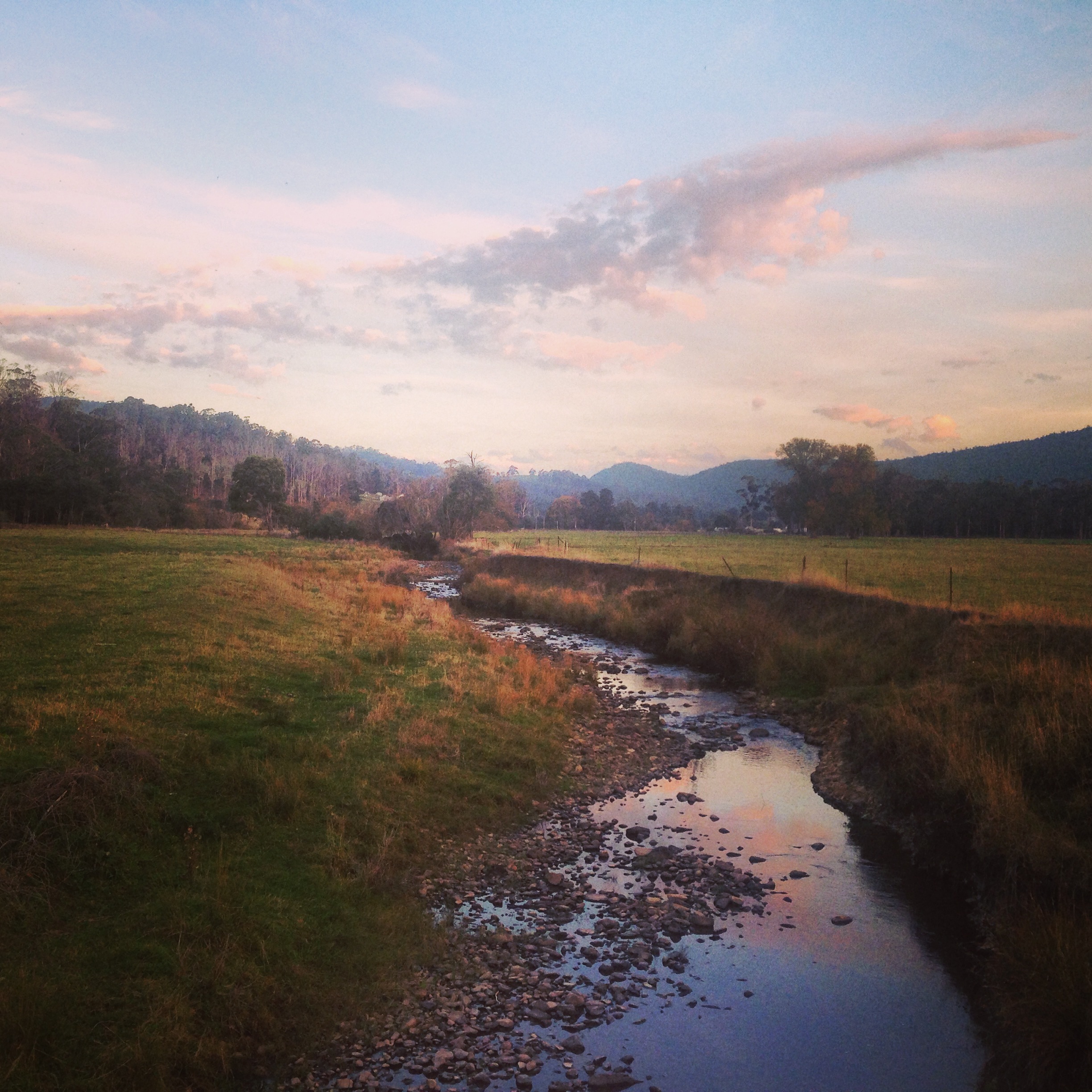
Pipers River, Karoola
The photo of Pipers River at dusk was taken just down the road. It’s a short walk down the valley I often do to take the measure of my patch, accompanied by the song of magpies and currawongs, a sky palette so delicate it brings you back to beauty. With each step it feels more like home.
I try and imagine what the valley was like before it was cut up and divided by surveyors into British land parcels of 500 or 100 acres and connecting roads. After a while – a long while – you feel it.
This pocket of the state celebrates well the discovery voyage of Bass and Flinders who named Port Dalrymple (now George Town) during their exploration of Bass Strait in 1798. History books make note of the first flag, first camp, first settlement, first port, and the first government house in northern Tasmania.
Before that, this was Stoney Creek nation, an area outlined, not by theodolite, but by the Tamar River to the west and Pipers River (or wattra karoola) to the east. I live in Karoola, an Aboriginal name meaning ‘medium sized stream’, first recorded by Joseph Milligan in his ‘Vocabulary of the Dialects of Some of the Aboriginal Tribes of Tasmania’ of 1859.
Until I knew this, my valley view had been that of tourist. Challenged by Aboriginal elder and academic Patsy Cameron to ‘listen to the voices of my ancestors’, now I see the landscape as Stoney Creek nation, one of nine Aboriginal nations or territories across the state.
As a writer, I struggle to find the words for what went before, finding a sense through seeing instead. I’ve created an Instagram hashtag (#stoneycreeknationtas). I’ll invite the students at Port Dalrymple School to post their own Stoney Creek nation images. Through seeing and sharing the landscape together, we might find more words, tell more stories, at least appreciate its unadulterated beauty.
Perhaps, through schools, this might spread to all the nations, and we could see our cultural landscapes come to life through a hashtag.
I hope the school assembly understands this sense of deep history I missed out on in that hall, and how they can make a difference by making the history of today. If one in 510 students understand that then I will have truly earned my spot on their Wall of Pride.
Wall of Pride selfie with Port Dalrymple principal Phil Challis
When I was asked by Friends of the Clifford Craig Medical Research Trust to address a pre-Mothers’ Day luncheon last Thursday, I didn’t feel 100% qualified to speak. While I have a mother, I’m not a mother.
Instead, I thought about the word motherly: resembling, or characteristic of a mother, especially in being caring, protective, and kind. I reckon we all have a capacity to be motherly. Even men. Well I hope we do. These are good qualities to nurture. Human qualities, regardless of gender, or however many children you have, qualities that make a better world.
Being child free, well, I’m not unusual. One in 5 women in the UK, Ireland, USA, Canada & Australia are now reaching their mid-forties without having had children – double what it was a generation ago.
Some women have actively chosen not to be mothers (‘childfree’), many are ‘childless-by-circumstance’ and find themselves living a life they never planned for. Whichever, child-free or childless by circumstance, no one had a roadmap, there were few mentors. But I know I have had fellow travellers.
Last Thursday, I introduced the 100 plus audience to five friends who are non mothers. I’ve known them all for ages, they’re scattered around the world; friends for life. Each of their responses to my email asking for a few words on being non mothers on Mothers Day amazed me in their generosity and wisdom. I’m sharing them here in the hope that either you, or someone you know, might find them enriching and nurturing, too.
VIV lives in a small village on Gran Canaria in the Canary Islands.
Viv & I, doing poolside cocktails at a rooftop bar in the Canaries
“When people ask if I ‘have a family’ I don’t say I don’t have children I just say ‘it wasn’t my destiny’. The real reason is really my mother was absolutely not maternal – and I’m not either so never had that ‘baby’ yearning. IVF and all that palaver sounds horrendous – and good luck to them who yearn for children. But I would have been maybe like my ma – resentful, unpleasant and critical – so it wasn’t for me.
Ma is now, at age 92, very pleasant. She seems with her dementia to have forgotten how to be insulting to me so at this late stage of her life we are at peace. But she did give my confidence and esteem a hammering and couldn’t wait to get me out of the house.
However, another real reason for non kiddiness is working as an au pair in my 20s. Then I saw the daily grind of having children – however delightful the children may be – and how hard and exhausting it was. How the woman takes most of the brunt of the rearing, teaching, discipline etc. The idea of adbreak super familiies all giggling isn’t really how it is. It’s a slog – unrelenting – and I understand why people have breakdowns. Going out to work and escaping – as all the husbands did – was much preferable than being home.
The positive result of au pairing was my long friendship and adoration of two children once in my care – now 45 and 47 years old – and I adore them. Also, friends’ children who I’ve known since birth who are my buddies. All of them email and call me when they want to talk about stuff they can’t with ‘the parents’ – who as you know are fab – so we have a connection. I have lots of children – but didn’t give birth – and love them.
Some people aren’t mother material. I’m not. Nor you. We are free spirits. We’re often accused of being selfish – which I think is silly – as you’re not and I’m hoping I’m not. We are necessary people to complement our close friends’ families and by that become a family extension.
The message is: we are all mothers. Just some of us didn’t go for the birth thing.”
DEB lives in London and we’ve been friends for nearly 30 years.
Deb (& Kerouac) smooching on one of her Karoola visits
“When people ask me if I have children, I can actually feel flattered…as though from the look of me they think I might…does that make sense? It makes me feel that there’s no reason why I shouldn’t have them? Because I did feel that I must look like a ‘marked’ women (ie failed, desperate etc.) when I was putting myself through the trauma of looking into having a child on my own.
Doctors investigating me, showed me fertility charts of hopelessness for women of my own age using their own eggs. One was so kind, another was brusque, another was gently admonishing. I felt ‘marked’ during months of fertility counselling, too. But the circumstances in which I was trying to force myself to have a child, were completely wrong for me – and it was a huge relief to realise it and allow it to direct my final decision not to go it alone in motherhood.
I have gained strength from making that decision, not become weaker or more ‘failed’. I observe the closeness between mothers and children, and it’s precious and unique, of course. I know that intimacy is not something I have, though I had it as a daughter. I’d like emotional intimacy, but with a partner. Whether I will mourn again at not being a mother, if I find that intimate partner, I don’t know. That’s the only time I’ve wanted to be a mother, is when I’m in love – another reason why I know pursuing motherhood on my own was not right for me.
As for what life has provided for me without children: perhaps more time to ruminate (bad) and an excuse to not change certain things, because the reasons for changing things have not come along.
Positively, I am a good auntie, I am a godmother, I get on pretty well with kids of various ages – and that again confirms I’m not a ‘marked’ person. I take great joy from interacting with kids – it chuffs me when they enjoy my company, or laugh because of what I say, that I might help them through something tough, or I might give them a way of thinking or experience that is valuable. It’s not the full monty of motherhood, but I cannot agonise more than I already have about that …that’s useless self-flagellation.
There are non-shallow and shallow benefits: travel without things chaining me home; get up/do stuff and sleep when I want (also bad as you have no constraints other than those you impose, which for a lazy sod like me is dangerous!); quiet; freedom, time to think (also bad sometimes).
I find the new mother has a 5-week old baby thing gloaty. And yes I fully realise that it is a trigger that makes me think ‘here we go again with the supremacy of the mother’. Their voice is so enormous and the childless woman’s voice is so small by comparison. Sorry if that sounds a bit ranty. Lots of love, hope my thoughts, ramshaklly written as they are, are of value. Deb.”
FIONA has just moved with her husband, John, from UAE to Chile.
Fiona contemplating the joys of being a ‘counterpoint adult’
“What do I tell people who ask me why I don’t have children? Funny but very few people ever do…however, if someone did, I’d say that I never actively thought I wouldn’t have children but then equally I never actively thought I would. Many years ago my first husband’s father said to me that children shouldn’t be planned but should just happen. As I’ve never been one to plan anything, the best explanation would be that they just didn’t happen for me despite long loving relationships. I never think about whether it was a good or bad decision – it is just how it is.
What has life provided for me by not having children? Firstly, an appreciation of children as human beings with all the hope and potential that comes with them. To me I have a clear role among my family with my nieces and nephews and my friends’ children to be the counterpoint adult — the person in the room who doesn’t have the ‘parental’ filters/processes and will respond to them as their own person — kind of like the rest of the world probably will except with a little more understanding and love. Secondly, the ability to do and be how I want to be, when and where I want to be me, with all the opportunities and trade-offs that includes.”
LEIGH is my oldest best friend in Australia, and despite running an important event that opened last night, she still had time to send me this note… she’s my best friend.
If you’re a Seven Summers reader, this is Leigh and I at ‘deepest darkest Africa’
“Hi Hon, I have the festival launch Wednesday and I broke my wrist last week. Surgery Thursday. I am not sure about my place in this discussion. I more identify as a privileged middle-class woman of a particular generation which lasted maybe 5 years (now 50-55yr olds) who were offered a life of shared houses, study, travel, living overseas, careers, social and political action, defactos, marriage, mortgages and babies – with no financial or age planning involved. No mention of priority – so some things fell off the list. Given my life, I never really made the decision not to have children. Also, my generation tended to separate consideration of abortions from motherhood. All said, I have taken the opportunities being childless allowed – but in honesty, what would have been different? I don’t know… I would like to think you and I would still have had our adventures together! Which reminds me – we must be due one soon! One-finger-left-hand-typing is bugging me, so call me tonight! Love Leigh.”
MARCELLE lives in London and has been a friend since we worked together at British Cosmopolitan in the 90s.
With Marce in the back of a London cab whizzing through Hyde Park
“Mother’s Day. Well – what everyone has in common is we all have/had mothers. Even if we didn’t know them. Most of us love our mothers – even if we might not have chosen them.
I don’t think every woman needs to BE a mother.
I’ve never wanted to be. I’ve never regretted it. There’s enough kids around for you to love and share while you get on with your life. Listen – I’d be in love with a Jack Russell puppy – let alone a baby. But I’m soul searching and honest enough to know it wouldn’t fit in with the way I live. There’s enough people to love who need you.
Mothers are often SO family-centred, so entranced by their own offspring, their own families – they aren’t aware of other people. I never wanted to be a mother even though I find children fascinating. I wanted freedom – to do, to see, to go, to achieve. Too many mothers forego that chance. And in truth some aren’t interested. In my time – it wasn’t possible, without money, to be a mother and an achiever.
I’ve never envied friends with kids. I know they’ve envied me. Neither of us would swap lives. And who’s the person who encouraged me to jump on planes, live abroad, learn, travel, have fun and company, a career I loved? My stay-at-home mother who’d love to have worked. She told me how lucky I was to have the chance.
Am I happier than friends with children? As happy, I’d say. You choose your life. And if you lead it reasonably well, it comes to about the same.
People have said ‘You NEVER got married?” Nobody’s EVER asked me why I don’t have kids.”
AUDREY
When I asked Audrey about being a mother – my mother – she said it had been wonderful. She says what she thinks now is that her whole life has been being a mother. She’s loved watching her children all grow up, all doing different things, and finds that fascinating. She can’t think of any downsides. Just the ups – and that it’s even better now, at her age, to have her children around her to look after her.
Flowers found blowing in the wind from the Karoola Cemetery
A couple of weeks ago an elderly man knocked on the front door and handed me a leaflet with the title “Millions will attend – Will You?” Inside, an invitation to the Memorial of Christ’s death at a Good Friday service and a meeting of the local congregation of Jehovah’s Witnesses.
In the era of social media it’s amazing how anyone still knocks on doors as a way of getting out their message. A neighbour says when they call he tells them he’s a Satanist. It’s one way of ensuring they don’t come back.
I told the caller I don’t believe in organized religion, that I do my own thing and that it is personal to me.
“Well, if you decide to come along, just ask for Leo,” he said, leaving the leaflet that also carried an invitation to a special Bible talk on “A Promise of Perfect Family Happiness”.
I don’t believe in perfect family happiness, or even the promise of it, so his god was not for me.
My father died on Easter Saturday ten years ago and although the date is different every year, that’s the day I think of him. Which is contrary and wrong, and of course I remember him at other times, too. But Easter Saturday is when his memory rises most in me.
It is a bit odd that I know more about the attitudes towards death of famous men who are dying than I knew about my own father’s who seemed immortal. Like playwright Dennis Potter, who, when approaching death said in a televised interview, “We’re the one animal that knows that we’re going to die, and yet we carry on paying our mortgages, doing our jobs, moving about, behaving as though there’s eternity in a sense, and we tend to forget that life can only be defined in the present tense. It is, and it is now only.”
Lessons on death, too, from comedian Billy Connolly whose TV program Billy Connolly’s Big Send-Off was a masterpiece in life and death lessons. In the end, the 71-year-old comedian who is diagnosed with Parkinson’s disease mused: “This is death…” Then, breathed out… leaving just silence and no breath.
Last year I had a cancer scare that proved to be nothing more serious than a stress related illness. I stopped doing things for a while to absorb the reminder of my own mortality. I felt little anxiety about death – it happens to us all – just that it might be a bit soon.
It’s not something families tend to talk about openly until someone has died. Having raised the subject on Facebook since then, clearly there’s a death conversation to have. Jillian wrote that ‘Death is evidence of life. You cannot have one without the other. My husband died suddenly when I was 30 and our sons were 2 and 9. Life goes on.’ While Jane wrote that she and her husband are more afraid of getting old than of dying, not having children to look after them as they age. And Grant said, “consider how much more scary endless life would be”.
When Radio National’s Natasha Mitchell invited a panel of five young people aged between 9 and 13 to talk about death last year, these were some of the answers she was given:
– The only thing we know is that everyone is going to die.
– Death is the end of your life.
– You will never see them again. Sometimes to reassure yourself you can think about them and you can feel that they’re there, but they’re not coming back.
– Death is when you don’t live.
– Death is like saying goodbye forever and you never say goodbye again.
And adults think death is difficult to explain to children…
Discussions about death have been made possible by the Death Café movement established by Jon Underwood in London a couple of years ago. Death Cafés aim to create an environment where talking about death is natural and comfortable. “We don’t claim to have answers,” explains Underwood. “We provide a place for people to come and explore their own attitudes to death and dying if they want to.”
And they do it with cake and tea.
Death Cafés are now a social franchise with 3000 participants in over 400 cafes. The only rules: the conversation happens on a not-for-profit basis that doesn’t lead people to a product, course of action or conclusion, and respects other peoples’ views and confidentiality.
Discussing death then becomes a useful way to ask what’s the best way to use the time we have left, instead of simply repeating our lives as we age, and being oblivious to the obvious. In this way, end of life care becomes as important as praying to god.
In Australia, a feisty Port Kembla community group has determined to take back the responsibility that most of us leave to someone else – to care for their own dead. An award winning documentary, Tender, was made about the group’s fight to arrange community-based funerals. You are invited to host a community screening in your area by emailing info@scarlettpictures.com.au
In Hobart, architect Robert Morris Nunn and Julie Payne, in their expressed desire to improve the process of dying, have put a proposal to the Calvary Hospital board to establish an independent hospice that would “help celebrate life in the midst of death”. (Tasweekend Jan 31-Feb 1 2015)
So, this past Easter, I have remembered my father, reflected on death, and reminded myself to have those important conversations about dying – while looking on the bright side of life, of course.
According to my teenage niece ‘grammar’ is when the teacher picks her up on using the word ‘like’ too many times in a sentence. I know what she means, but next birthday I’ve resolved to give her Strunk’s The Elements of Style and hope some might rub off.
Sadly, grammar is as out of fashion as handwriting; texting proves that you can be understood without being good at either.
Australian English has always been a looser version of the English language. I’ve always loved our ability to shorten and make casual words we use regularly or for which we have a fondness. For example, I love how redheads are called ‘bluey’, sandwiches are ‘samos’ and parmi nights are all the rage.
But grammar matters. I wish it were still taught, and, as a writer, feel indebted to Mr Kitchener for banging it into us in English. Monday afternoons will always be remembered for the slog of double grammar. It taught us to respect the structure of the written word, to order our thoughts, play with rhythms, organize paragraphs, and how a sentence could be altered just by switching a clause and a predicate, although I still don’t understand why a dangling participle is such a bad thing…
A recent review of the Australian Curriculum found undergraduates possessed “at best a rudimentary knowledge of English grammar”, had “learnt nothing of English grammar at school” (to the point where even identifying the parts of speech in a sentence is beyond them), and that “their grammatical errors were routinely left uncorrected in their essays”.
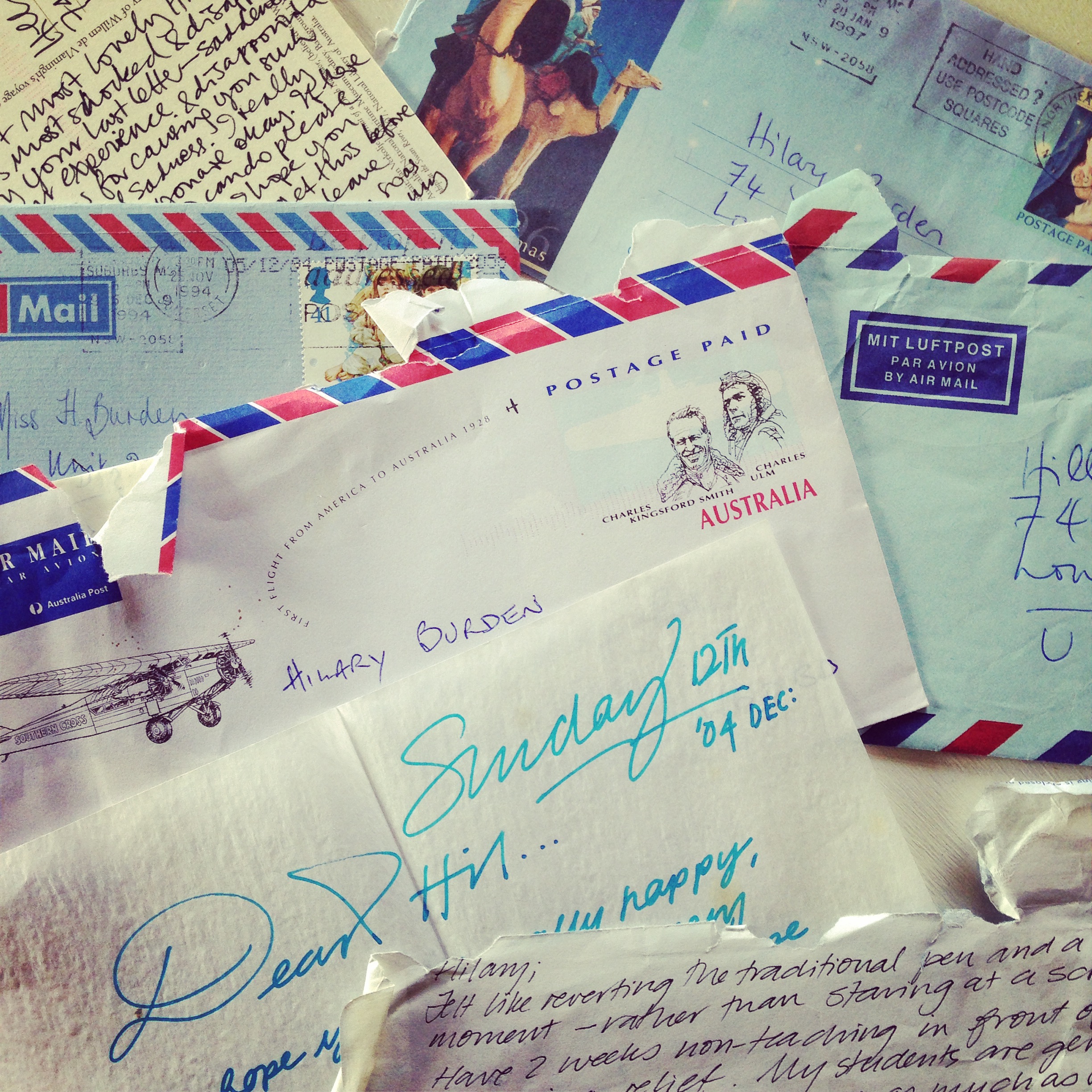
When it comes to handwriting I also crave that it matters more. I’ve kept drawings from my niece as a toddler before she even knew how to write her own name – scrawled, tenuous letters that can’t find a straight line, hesitant and broken tracks of crayon, patiently awaiting practice. But since those baby steps I’ve never received a letter – only short emails, written, mostly, in text speak.
I want to urge: get off the computer! Leave your desk. Go outside. Sit under a tree. Pick up a pen, a pencil, a scrap of paper or journal – I don’t mind – but use your hand, your whole hand. Not two thumbs. Tell me a story with all your heart and soul and let it leak through your hands and all your fingers, spill and splutter onto the paper, go back and check or don’t. Just use your hand and make it flow.
A friend who works at Australia Post says only 3% of mail posted these days is by personal letter – a figure that floored me. Communications Minister Malcolm Turnbull confirmed it on 730 with Leigh Sales. It’s well known that Australia Post’s letter arm profits have been plunging for the past seven years, and that the cost of a stamp is set to rise to $1 for letters as email replaces physical mail.
How I will miss that feeling of first seeing the postman turn into the driveway then running to the postbox to check what’s arrived. These days there are envelopes but rarely letters. It’s hard to imagine ever waiting on two deliveries a day in the UK.
While worrying about the possible demise of the book, the handwritten personal letter has caught me by surprise because if people aren’t writing letters to each other – and I mean letters, not cards – something human is lost.
There are good arguments for re-acquainting ourselves with writing letters, apart from Oz Post profits.
* If you agree with Edward Snowden that ‘there is no such thing as privacy’ – emails can be read by anyone and our phones tracked – a handwritten letter is safer and more intimate territory, free from the metadata police.
* As a writer, I know that when I start a story, doing it by hand, away from the computer always gets me in the zone. It’s different to putting thoughts straight onto a keyboard. Writing by hand connects to something more primal, more human, a step closer to our sub-conscious.
* In years to come you will find slips of paper inside books, notes scrawled in a journal that will stop you in your tracks and take your thinking into another place. The computer is a void that devours rather than gives.
The upside according to Oz Post is that 25% of parcels are delivered by posties, so just because the letter is dying, doesn’t mean the postie has to die. But this means we are sending things not thoughts.
My grade 3 and 4 teacher Rita Miller taught me how to write using cord cursive. “They don’t teach it any more,” she told me when I called her to refresh my memory of how she taught us to write. “If they do teach writing it is abbreviated script. My grandchildren say ‘Print to me’ because they can’t read linked-up writing.”
I remember now how Rita taught us to make our letters flow, how we’d concentrate on one letter, get that right, and move on to the next. Music was played over the school’s public address to classes from grade 6 down to 3. We’d write in time to the music, doing waves and hoops to a march time beat.
Every now and then Rita does a few hours’ relief work at the Low Head Pilot Station, an historic maritime museum dating back to 1805. I can see how she watches the children who visit, how she’ll ask them kindly to write in the visitors’ book. They’ll take hold of the pencil with their fist and she’ll think how ungainly it looks, how it must ache to write like that, and yet understand because how would they know otherwise?
Always the teacher, Rita thinks at least they might be taught how to hold a pen properly.
First published in Tasweekends, Saturday Mercury, 2015
My Grade 3 teacher Rita Miller (at Low Head in March 2015) taught me how to write and hold a pen
When did you last let yourself play? Not sport or games or politics. I mean play like children: inventing, creating, making or surprising… without imposing all the rules that adults seem to need to set, turning life into routine and mere existence.
As a full time mother to two girls, 5 and 3, my friend Sophie rarely has time to herself: thinking, being, resting or just empty time. It’s how she wants it but that doesn’t mean it’s easy. As a writer my days are the exact opposite: crammed with all the space and solitude I want, often carved out by pushing people away. For me, it’s the real people bits I sometimes crave.
So when Sophie and Matt asked me to spend a couple of days with them and the girls at their shared holiday shack in Swanwick, I didn’t hesitate. The only thing planned: a walk in Freycinet National Park without the girls. Matt was able to put his remote-work aside for a morning, just especially.
We decided against Mt Amos because it seemed like an obvious track. Sophie had once worked in the park as a discovery ranger and suggested the lesser-known Mt Parsons climb you take from Sleepy Bay. Several couples were lapping up the day in the bay, but there seemed to be no one venturing further up the rocks, climbing steadily over granite boulders marked by rock cairns and white flowering ti tree. We made our way making unplanned stops, to stand or sit and chat, as you should, on a hike with no agenda. Had conversations that spring from sharing a walk with a friend who likes to notice things more than you.
Our conversation somehow softened the drama along the way: the surprising caves and crevices, broad caverns and high gullies that we passed through seem even more astonishing now I recall them. But the ginger footsteps we planted firmly to look down over the cliff’s edge were very real. It reminded me of the Amalfi Coast, except if we’d been there we would have been sipping cocktails next to a swimming pool it’s that populated.
We had climbed high enough to see all of Coles Bay township when Sophie pointed out a rare mountain dragon (the only species of the dragon family living in Tasmania) darting under a rock. I loved how she could master distance and detail too.
It didn’t matter that we didn’t make it to the final 360-degree viewing peak. We needed to get back before the girls’ afternoon nap. From our vantage point we looked out over a vast landscape and decided this was our wilderness moment for today, only two hours from the dining table: to be on The Hazards on a clear day, sharing a sense of stillness unchanged since these granite peaks were formed. We savoured the same breeze on our skin that carried sea eagles above.
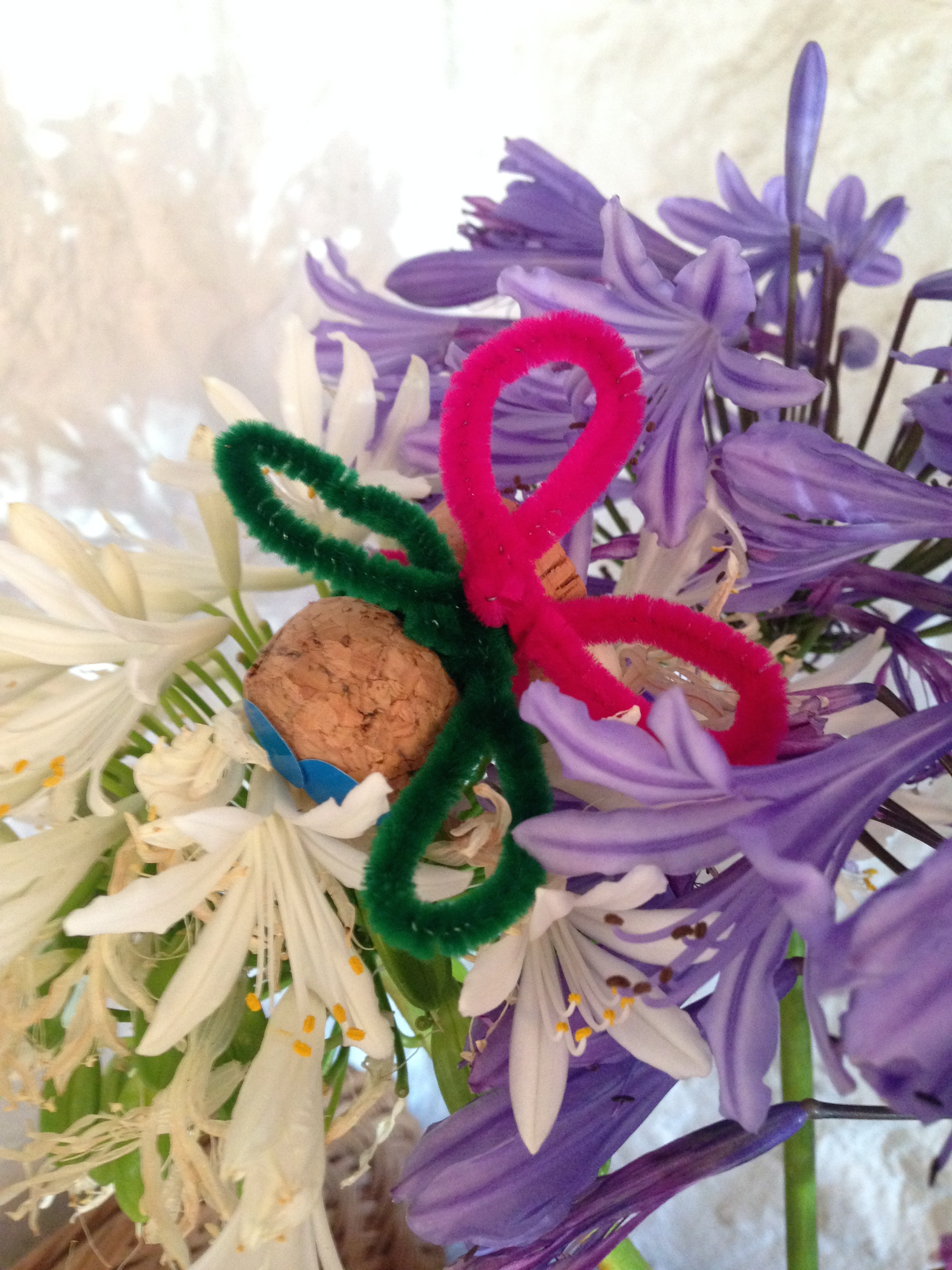
While Sophie and I had collected time together, when we returned to Swanwick her two girls had been playing and made a Welcome Home for their mother and her friend. They’d turned last night’s champagne corks into bees with neon-coloured pipe cleaners for wings. Skipping around the long dining table with their cork-bees held above their heads, each imagined them into flight with a gently hummed “bzzz, bzzz, bzzz”. It was the sweetest thing.
When the world goes violent you would want the bzzz of all its children to be heard above the drones and bombs and planes. Not having children I can’t fathom why adults would want to spoil a little person’s: cuddles in bed in the morning; taking you by the hand on a walk to pick flowers; climbing on to your lap to hear a story being read from a book; grabbing you by the neck when you swim in a river; sitting on your crossed leg asking to be bounced…
Imagine a world where the urge to protect child’s play is more powerful than the urge to go to war.
It is a TV screen-free home in line with the teachings of the Tarremah Steiner School near Kingston that both girls attend. For the first seven years of life, children brought up the Waldorf/Steiner way are allowed free creative expression (“when you look at a child, there’s your curriculum” explains one teacher). The focus is on creative play, stories and interaction with nature within a nurturing beautiful environment.
It is the height of irony that while many schools follow the lore of the Ipad, allocating screens to every child, the children of Silicon Valley executives are being sent to schools where there are no computers or electronic devices. A 2011 New York Times story reported that engineers and executives from companies like Apple, Google and Yahoo were sending their children to a Waldorf elementary school in California where children are discouraged from watching TV or logging on at home.
Even the late Steve Jobs, in an interview with technology reporter Nick Bilton on the launch of the Ipad2, admitted his three children had not been used as guinea pigs for his Ipad and were even limited in how much technology they used at home. Instead, they were allowed to play.
When the referee says ‘let’s play’, let’s remember how we played like children. Try to recall what you loved as a child: running free, singing without worrying, dancing without thinking, painting without a care, asking questions without fear.
We may think we know it all but when we play we are forever learning.
First published in Saturday Mercury, Tasweekend 28 March, 2015







 Hilary Burden