Count blessings, not years

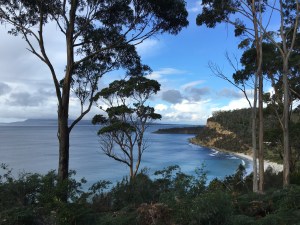
Shane Gould on her early morning ocean swim at Bicheno. Photo: Hilary Burden

I’ve watched two friends turn fifty this week. Twenty, 30, 40, 60… new decades have a way of making us reflect more on where we’ve come to and what we want next. Their birthdays have brought to mind that great Joan Rivers’ saying, “Looking 50 is great if you’re 60.”

There’s something about turning half a century old, however, that makes people stop and think, reflect and plan, sometimes panic. It shares the same fears and expectations of seeing in the New Year – but for your life. You need to be with the right people, in the right place, have the right face on to front the second half.

The recent National Aged Care Summit in Hobart had us thinking about getting older. We heard about the “tsunami of old people” on our doorstep, “the baby boomer bulge”, and how Tasmania is the oldest state in the country (with 16% of our population aged 65+), and ageing faster than any other state. We learnt how demographers divide our ageing population into ‘young olds’ (60-74), ‘mid olds’ (75–84) and ‘older olds’ (85+). How, based on the 2011 Census, 1 in 6 Tasmanians were aged 65+. In 2020, they project that will be 1 in 5, and 1 in 4 by 2030.

In focusing too much on the measuring of age, somehow we wind up thinking an ageing population is a bad thing. Maybe when you count things they get worse. Can we learn to use different words, like ‘the elders’? Or, ‘people older than us’? Or, people in the second half of their life, however long that turns out to be?

Then we might stop thinking of old age as if it were a disease, and more of the mystery that it is. Elders and people older than us are individuals, rather than an expanding, homogenous mass. They know more, have lived longer, weighed it all up and spat it back out. They’re survivors, not on the downhill run of a demographer’s measure.

We are counting too much. Thanks to a friend (who’s about to turn 60) I’ve recently discovered there’s a word for it: “performativity”. She gave me a paper by sociology professor Stephen Ball who defines performativity in an education policy context. He says, “It requires individual practitioners to organize themselves as a response to targets, indicators and evaluations. To set aside personal beliefs and commitments and live an existence of calculation.”

In his 2001 book The Tyranny of Numbers David Boyle wrote, “We take our collective pulse 24 hours a day with the use of statistics. We understand life that way, though somehow the more figures we use, the more the great truths seem to slip through our fingers. Despite all that numerical control, we feel as ignorant of the answers to the big questions as ever.”

When I think about the elders I know the arc of their lives is so much more fascinating than the short-lived burning desires of youth. Many are spending the second half of their life recovering from being a young person. Many are off the track we think we all need to be on and doing the things they want to do – an attitude often mistakenly thought of as ‘grumpy’. More often than not it’s just contrary to what is expected of them and they’re finally free of paying up and shutting up.

My 50-year-old friend decided to take her motorbike test and buy a second hand bike. She’s riding it now in leathers and beeps every time she roars past the house. At 69, another friend has signed up to study an online course in geology. Another, at 59, starts each morning with an ocean swim. Their age is not the important thing. They’re living a life well lived.

My friend who turns 50 today said how hard it was to hear people complaining about getting older when others haven’t had the chance. Tonight, as she gathers to sing, dance and count her fifty blessings with her loved ones and closest friends, she’ll miss the friend who didn’t make it. She’ll think of others turning 50 who’ve dealt with so much more grief and heartache. Which is why she’s seeing her 50th as a once in a lifetime occasion.

I asked for her thoughts on turning 50. “Life goes fast and can change in a instant,” she wrote, “and so 50 seems as good a time as any to take stock, say thank you, tell the people you love how important they are to you and challenge yourself to live the next stage of your life as best you can.”

Next week she’s jetting off to New York for the first time. Fifty’s a number she’s chosen to embrace. Meanwhile, I’ve been raiding the book of milestone birthday quotations, and chosen this by Albert Einstein.

“People like you and I, though mortal of course like everyone else, do not grow old no matter how long we live…[We] never cease to stand like curious children before the great mystery into which we were born.”

Happy 50th Birthdays to Roisin: thank you for your magic and words, and to Bron: thank you for your friendship and all the loving things you do.
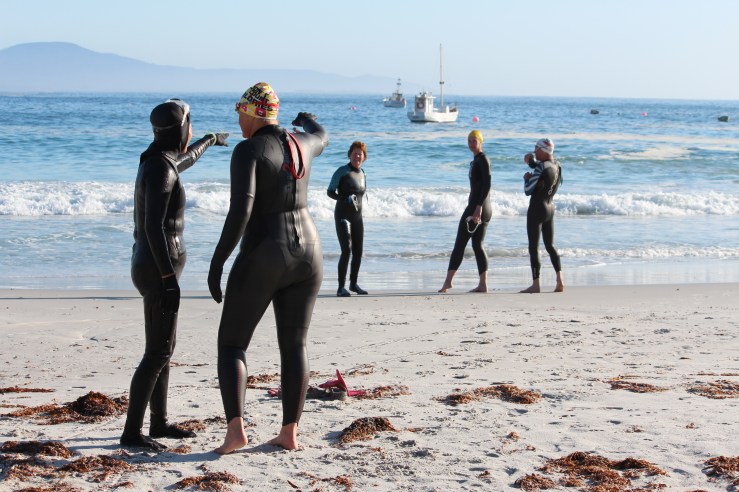
Coffee Club ocean swim group, Bicheno
Coffee Club ocean swim group, Waub’s Bay, Bicheno. Photo: Hilary Burden


In a league of their own

Watching the Hampson-Hardeman Cup, the AFL Women’s All Star Match, last weekend you couldn’t help but notice how good it was and how well it flowed. Women have played football for 100 years – we just haven’t seen them.

We’re watching something new. And it’s proved a TV ratings success, with over a million viewers nationally tuning in to watch the Saturday game, and a record for any Saturday night AFL match.

Culturally, Australians are not accustomed to seeing a team of strong women play high profile sport. We’re used to tall and agile women make a name for themselves in netball or basketball. Swimmers and tennis players make front-page news, often more for their looks than their skill.

Sure, there’s women’s cricket and soccer teams that rate a mention now and then.

But AFL is different. It’s Australia’s game and a contact sport, reflecting a unique culture. It’s fast, tough, and calls for skill at kicking, hand-balling, marking and tackling. Until now, women mostly made news for being glamorous wives – ornaments not equals – certainly not for kicking a goal from 55m, as the Demons’ Tayla Harris did.

img_9589

The genie is out. Women who love to play footie will no longer struggle to be noticed or have a voice. They have a league of their own. The inaugural national women’s league kicks off in February 2017.

Last weekend, the Western Bulldogs and the Melbourne Demons ran onto the Whitten Oval wearing smiles. There were blondes and brunettes, ponytails and headbands. No one even cared if they were wearing makeup or not because their passion and talent was what mattered. What they came to do was what counted. No mention of hip measurement or cleavage. This is what happens when women are treated equally and respectfully.

One reporter observed it was all commentators could do to keep up with the play, at first stumbling over terms like “ruckwoman”. Soon, it will be the norm.

Our Watch (part of the government plan to reduce violence against women and children) partnered with the AFL for last Saturday’s game. They’re onto the value of this, while sponsors are also beginning to sit up and take interest.

Our Watch CEO Mary Barry said, “Sport has an influence way beyond the field it is played on. Providing opportunities and pathways for young women and girls to play AFL at an elite level normalizes the role that women play in our sport – on the field, in the clubroom and in the boardroom. Gender equality is at the core of healthy, respectful relationships.”

While men have often hidden their emotions behind the game, there’s something different happening with women players. We know already Moana Hope, who scored 6 goals for the Bulldogs and was best on ground on Saturday, is from the school of hard knocks. And Katie Brennan is a former bulimia sufferer who now sees beauty in and harnesses power from physical strength.

“Strong is the new pretty”, said Brennan memorably.

The new code marks a continuation of a necessary evolution for the AFL. Racism and sexism have long found common ground, on and off the field. Just as footy fans are being challenged to focus on the player not colour, this goes for women too, being recognised for who they are and what they can do, not what they look like.

Bulldogs vice-president Dr Susan Alberti is at the heart of the revolution. She was one of many signatories to a letter of complaint to Channel 9 about their treatment on The Footy Show. Sam Newman called the signatories liars and hypocrites and Alberti fought back, suing for defamation.

An apology from Channel Nine was read out in court, saying the network had not intended to impute Dr Alberti was a liar. She received $220,000 compensation, ironically helping to fund the women’s league.

Alberti told Australian Story, “I believe the culture of any organization, particularly AFL, it comes from the top. And I was making noises behind the scenes, albeit ruffling a few feathers, saying this is crazy, why haven’t we got women playing AFL football? It’s not a privilege, it’s a right.”

Racing Victoria should consider itself on notice, using topless models alongside horses and men in suits to advertise the upcoming Spring Racing Carnival. It was only less than a year ago Michelle Payne became the first female jockey to win the Melbourne Cup.

The AFL said that amongst the final total of 6,365 at Whitten Oval were “little girls sporting the unusual combination of over-sized footy jumpers and fairy dresses”. Now that’s a look. And, in a second-quarter televised interview, Bulldogs President Peter Gordon proudly said, “I see a future in which girls know that they can not only watch the game and love the game but play it at the highest level. It’s fantastic to know that half the population, the female population, get to play this game, get to start up a league of their own.”

The Hampson-Hardeman Cup is named in recognition of female football pioneers Barb Hampson and Lisa Hardeman who developed the first women’s championships in 1998.


First published in TasWeekend, September 10, 2016

Touring the new Tate

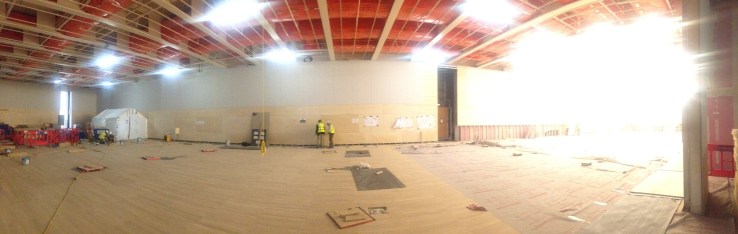
Inside the new Tate extension last August 2015
Inside the new Tate extension, London, last August 2015

Tasmanians know well the transformative powers of a museum.  This week, flocking to MONA’s Dark Mofo festival, they were feasting outdoors in bitter winds, preparing to swim naked, or practising a day of silence to mark the Winter Solstice.

Yesterday in London, after 8 years in construction, the Tate Modern extension had its official unveiling.The parent building opened 15 years ago in a former 1950s oil-fired power station on the south bank of the River Thames and is one of the UK’s top three tourist attractions with 5 million visitors a year.

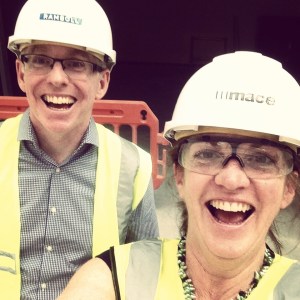
Last year I was fortunate to have a private tour of the new extension with Martin, my twin, the project design director for Ramboll in the UK, responsible for the structural, facade geotechnical and civil engineering design. It’s been his passion for 8 years, from appointment to opening, including a pause and partial opening of the oil tanks for the London 2012 Olympics.

When I’m in Hobart I feel connected to my twin. Marty graduated from UTAS with a Bachelor of Engineering in the 1980s and one of his first jobs, with Philp Lighton Floyd Beattie engineers, was on the Port of Hobart control tower near Constitution Dock where I feel he’s watching over me. He left his mark on the North Hobart Oval stand, too, and the Tasmanian Museum and Art Gallery’s Macquarie St entrance.

In London last summer, donning compulsory hard hat and steel-toed boots, I was able to trip through the inside of this amazing space from my brother the engineer’s perspective.

You have to understand the engineer’s perspective isn’t sexy. It often involves holes in the ground, particulars about building materials, and measurements that fail to translate into the kind of awe you know you should be feeling. Frequently the engineer’s discourse incurs grumbles about architects who seemingly get all of the glory while engineers have about as much profile as, well, a hole in the ground.

But I’ve learned to appreciate that what holds up a building is as important as what you see and how you live in it. So often the message is lost in translation, with attention gravitating towards the design instead, rather like moths to flames.

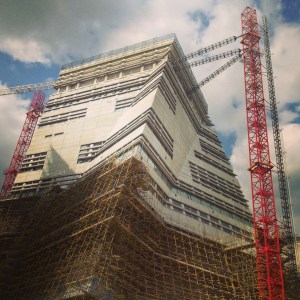
Last August, Marty told me how this building was structurally and geometrically unique: using a “bricks and sticks” system designed and developed by Ramboll, with not one single right angle. Practically every form of concrete is employed (insitu, precast, post tensioned, exposed, panelized, and three-dimensionally framed), and, on top of it all, spans London’s highest and newest steel pedestrian bridge. The perforated sloping masonry façade – like a piece of giant origami – contains vast cathedral-like spaces.

IMG_4237 IMG_4242

What I truly appreciated about this building, even a year before completion, was how it made me feel. Despite being surrounded by busy builders in high-vis and hard hats, I wanted to dance right through its open levels laid with unstained oak timber flooring and waltz down spiraling staircases that put people first.

The £260m extension, called the Switch House, revolutionizes the idea of a public gallery.  The 11-storey high brick pyramid is built on top of oil storage tanks that once serviced the power station. Designed by architects Herzog & de Meuron, it provides an additional 60% of gallery space dedicated to live art, film and installations – what Tate Modern’s Director Sir Nicholas Serota calls “a different kind of art because in 15 years art itself has changed”.

As MONA-goers know, art is being experienced and lived not simply observed or viewed. You get the sense that this will be the measure of this Century.

Aside from this week’s reviews, design critiques and fancy openings, I remind myself what this building does is put the common brick centre stage.

The hanging gardens of Babylon, one of the Seven Wonders of the World; the Great Wall of China, the largest man-made object on the planet; the Hagia Sophia, one of the most beautiful churches ever built; the structure of India’s Taj Mahal; the unforgettable profile of the Chrysler building in New York – all these have one thing in common – they were built out of brick, perhaps the most ubiquitous and yet least regarded of materials.

At the Switch House, 380,000 bricks were placed on the façade, matching those on the existing museum, but at the same time creating something radically new – a perforated brick lattice through which interior lights glow in the evening.  Yanchee Lau, the design associate and expert at computational design in 3D, spent the majority of his time on the brickwork. “We gasped at the ambition, barely able to grasp the level of attention that it would demand from us,” he said, “but we knew that it was going to be special.” Lau began the process of drawing every brick and anointed each one with a name.  Hand-laying each and every brick, he says, was central to assembling it.

Marty told me Derek Byrne, the man who laid the new gallery’s first brick in August 2014, laid the last one on Valentine’s Day this year before the ten-week process of disassembling the scaffolding. When I asked more about Derek, Marty emailed that he looked a very seasoned, well-worn brickie, probably in his late 50s, from Essex where his company is based. “He’s super proud of what he and his team accomplished. They’re now moving on to develop ideas for Roman Abramovich’s new football stadium for Chelsea – where 6 million bricks are required.”


Twins
Twins


Where else in the world?


Wilhelmina, Orlando & Denvor at Orford, with Maria Island in the background

In my 20s I lived and worked in Hobart and spent holidays in Orford, doing the sort of stuff we take for granted in Tasmania. Typically: sailing, boating, fishing, snorkeling and diving.

Back then I remember watching a young girl with long, sun-bleached hair ride a horse bare back down the road to Millingtons’ Beach; two boys kept up on foot behind. Although not knowing who she was, I’ve carried her image with me throughout my life – a tantalizing reminder of the lifestyle I’d left behind to follow jobs in big cities. To me, that young girl oozed natural spirit and outdoor freedom – a symbol of a special Tassie way of life.

I’m telling you this because last week I happened to meet that girl – a young mum called Wilhelmina Rea. Now 32, with two boys Orlando, 4, and Denvor, 3, she still holidays in Orford, at Porthcawl, the home barged over from Maria Island during the Depression by her great grandfather Len Nettlefold.

Rea is one of a growing number of residents who’ve joined Marine Protection Tasmania Inc. They’re so alarmed about Tassal’s plans to develop a 28-pen fish farm in Okehampton Bay, Triabunna opposite the World Heritage Maria Island National Park, in April they started a campaign: “No Fish Farms In Tasmania’s East Coast Waters”. Vice President Grant Gaffney, who’s been diving on the east coast for 30 years, confirms 490 local and 1500 online signatories.

Locals walking their dogs on the front beach stop to swap the latest with Rea. They tell me they feel the concerns of families who’ve holidayed there for generations have largely been ignored. Information days, they say, do not equate to securing a social license. They’re worried the Marine Farm Planning Act was written in 1995, and want to see a new marine approval process for the fish farm instigated because the lease for fin fishing in Okehampton Bay was granted nearly two decades ago, to Spring Bay Seafoods. A lot has changed since then, they say, not least rising sea temperatures, toxic algal blooms, severe depletion of fish and abnormal coastal erosion.

Tassal, Australia’s largest salmon producer, stresses it has undertaken engagement in the area. “We may not have everyone on the same page,” says CEO Mark Ryan, “but we’re doing it within the rules and being accountable”. “For us to have a social license doesn’t mean we have to please every single individual.” Marine Protection Tasmania remains far from convinced – with some 2000 voices Tassal has failed to convert – and are focused on the next stage of their campaign.

I used to sail in a trailer sailer across to Maria from Orford, so I know what Rea means when she says she’s grown up swimming with dolphins in Chinaman’s Bay, fishing for crayfish in a bikini in knee-high deep water, floundering at night, and counting shooting stars through the boat cabin window. She shows me a photo of her, aged 2, in nappy and lifejacket, fishing with her father who’s holding up the biggest flathead you’re ever likely to see.

IMG_2570
Wilhelmina fishing with her late father, Robbie

“I’ve always dreamt of doing that with my own children,” says Rea. “I want them to have the same experiences and opportunity on the East Coast as I have.” She says Orlando was in a boat when he was 3 weeks old, and Denvor even earlier than that. “I’m nurturing the same thing.” But with the onset of East Coast fish farms Rea believes much of that is at stake.

Orlando runs up to greet us on the beach with a fist-sized crab shell he’d just found. “Never in my wildest dreams would I think all this would be taken away from me,” observes Rea. She and her mother, Willie, are preparing for the kind of battle they never thought they’d have to fight. Already, Orlando talks of fish farms collectively as “poo poo fish farms”.

Sharing crab shells
Orlando sharing crab shells

It’s not just her boys Rea cares about, but generations of other family histories she hopes to protect. Next to the old Aga in the Porthcawl kitchen hang two framed photos: her mother in the arms of Wilhelmina’s late father Robbie, on their honeymoon on Prosser Bay. Rea says her parents had packed up their Sydney lives in the back of a Holden after “cracking it in a traffic jam”. They even dug up the lemon tree and stuffed it in the boot of the car before driving to Tassie. That lemon tree survives and has broad branches now.

Willie and Robbie on honeymoon on Prosser Bay

As children, Rea and her three brothers, fifth generation Nettlefolds, spent every weekend and entire school holidays going up the coast to Porthcawl, sailing to Maria Island in “The Rose”, four kids squeezed in with windsurfers, boogie boards, surfboards, diving gear, fishing, and “epic amounts of food”.

She says every day her mother worries about where else they will go if fish farms eventuate and the waters where they’ve played are changed for good. “Do we have to think about moving to Flinders Island?” she ponders.

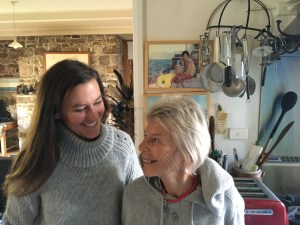
Mother & daughter
Mother & daughter

Rea says she’s not against fish farms, just not in these waters. She knows there are more sustainable ways of farming fish and wonders why farming has to take place in the bay where locals have always played and fished.

Willie minds the two boys as Rea sifts through folders of facts, papers, and letters. Orlando wants his mum’s attention but she’s preoccupied, pointing out that Tassal’s proposed timeline of works for Okehampton Bay (detailed on their website) is starting shore base construction this year and installation of marine infrastructure in 2017.

“It’s not just me, but so many families share a proud connection to the culture of this coast,” says Rea. “I teach my boys how to catch crayfish from the paddleboard. Where else in the world can you get that? Where else can you light a fire on the beach and have lunch together eating fresh crayfish? If we have fish farms in our East Coast waters, chances are we won’t have that anymore.”

“Where else in the world?” matters. It brings us home to ourselves. Our island connections to land and sea matter, as much as our need to exploit them. Any doubts about that cause sleepless nights for those with caring hearts.

Stapletons Beach overlooks Maria Island
Sheer beauty: Stapletons Beach overlooking Maria Island

Tassal is holding an Information Display of the Okehampton lease and shore base operations at the Triabunna community hall next Saturday, June 18, 10 am – 2pm.

First published in TasWeekend, June 11 2016

That’s me, sailing on Prosser Bay

Following in the footsteps of our First People


2016-01-11 14.11.29
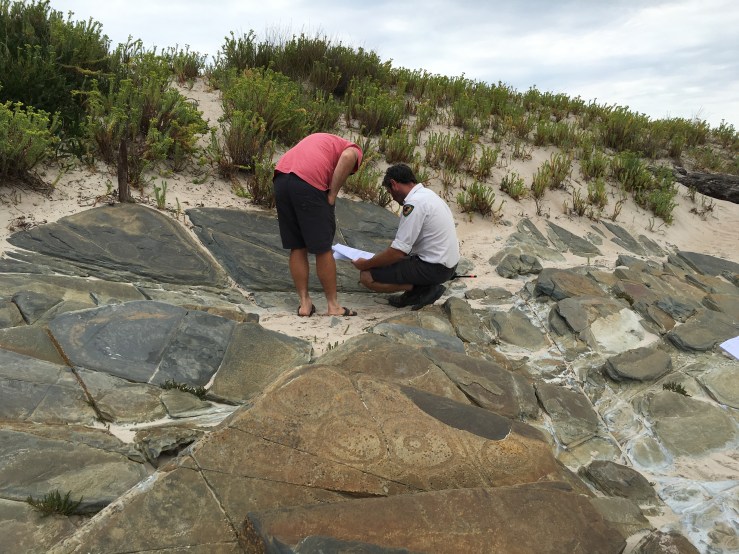
Viewing Tasmanian Aboriginal rock carvings/petroglyphs at Sundown Point on Tasmania’s West Coast

We’re on a route that takes you directly to one of the rich Aboriginal sites on the wild West Coast. This sea country fills you with awe. The track itself is an adrenaline-rush: deep, rocky ruts and soft sand make it 4WD only.

You have to know where you’re going. Or go with someone who knows. And shoulder a rucksack of respect because the Arthur-Pieman Conservation area is one of the world’s great archaeological regions. A 2km wide coastal strip from Marrawah in the north to Granville Harbour in the south sits on the National Heritage List.

At Arthur River’s Gardiner Point, more commonly known as ‘the Edge of the World’, you stand on rocks further south than the southernmost point of Africa. Waves breaking onshore here arrive all the way from Argentina, uninterrupted by land. Scientists at the Australian Maritime College who study and measure oceans acknowledge these are the world’s most powerful.

Some of Tasmania’s rare Aboriginal engraving sites are located on this coastline, just metres from where we pull up in the 4WD. At Sundown Point, 8kms south of the mouth of the Arthur River, we clamber over and contemplate 40 separate rock slabs of laminated mudstone, many with clearly defined circles, grooves, lines, crosses and pits scored thousands of generations ago. Middens and hut depressions, too, are evident along the coastline where Aboriginal people survived in large numbers for thousands of years, and were forcibly removed in the 1800s.

If you were here without a guide you’d be hard-pressed to find or see the rock art. Drifts of sand cover many of the motifs. Our lack of education and ignorance form a double crust. Like many, I was taught that Aboriginal people did not survive what Tom Lawson in his book The Last Man calls “A British Genocide in Tasmania”. We learnt about how the First People died, not how they lived, or their descendants survived.

I find myself on this path, now, with Aboriginal friends, trying to fill the chasm of unconsciousness, and honour a culture that goes deeper then we ever knew.

I think of these flat rocks at our feet on drifting sands as are our Stonehenge, our Macchu Picchu, our Leaning Tower of Pisa.

For non-Aboriginals the journey of discovery is neither obvious nor easy. Access to these coastal sites has been won, it seems, without a robust framework for deep appreciation. We are still learning how best to protect and manage Aboriginal living heritage. A Liberal election promise advocated the upgrading and re-opening of a number of 4WD tracks in the Arthur-Pieman. But, the Federal Court ordered an interim injunction to close them, ruling heritage must come first.

There were signs of a change of heart when, this Australia Day, Will Hodgman spoke boldly of his government’s intention to overhaul eligibility for Tasmanians identifying as Aboriginal. The local Aboriginal community, represented by the Circular Head Aboriginal Corporation (CHAC), hopes the Premier’s speech will open doors to a new approach for local Aboriginal people to manage and look after their own local heritage.

“There’s one Aboriginal group that speaks for the Tasmanian Aboriginal communities – but they don’t speak for us,” CHAC CEO Diane Baldcock told me. “We have our own voice.”

Currently, permission to access the area is required through the Tasmanian Land Council and Tasmanian Aboriginal Centre that run a site office a few kilometres up the coast at Preminghana (Mt Cameron West, Marrawah). The signs here indicate we are on Aboriginal land and we stop respectfully to ask permission. On a holiday weekday the building is closed with no one in sight so we continue to the lookout point at Preminghana.

Since the area was first discovered in 1933 by Devonport school teacher, A L Meston, Preminghana’s engravings have been recognised as “one of the finest displays of hunter/gatherer art in the world”. Even in the 1930s Meston referred to their advanced state of erosion, while a later paper by L E Luckman, published for the Royal Society of Tasmania in 1951, with photographs and maps of their location, also referred to “important material, much of which may be lost by erosion”.

By contrast, in the distance, the outline of Cape Grim is a permanent reminder of the massacre that occurred when shepherds ambushed a group of Aborigines, throwing their bodies over the cliff into the sea.

Diane Baldock, who’s lived at Circular Head for 36 years, explains how many local Aboriginal people have been denied access to their own culture for “many, many years”. “I know there are members of the community who have been to Mt Cameron and been prosecuted for being on site at Mt Cameron and gone through the courts even though they identify as Aboriginal people”.

“We’re not about claiming land or land hand-backs,” says Diane. “We want to be able to share our rich culture. It would be wonderful to have a plan in progress for access because it needs to be managed and controlled carefully so we can enrich our sites and be able to pass on our heritage to our young people in the community who will be our future leaders.”

Meanwhile, on the TAC website, CEO Heather Sculthorpe, disappointed with what she calls “Hodgman’s gimmick Aboriginality policy” threatens to “raise the attitude of the Premier at the next large gathering of the Aboriginal community where it is likely we will be told to cut off contact with the Hodgman government.”

Much has been written about the Black War. But in 2016, we fail ourselves in failing to fully connect with the awesome beauty, stories and culture of our First People. There is a right way to observe deep culture and all Tasmanians need to be shown how – be guided, not with signs of authority, closed doors, or threats.

It helps if you let someone take your hand – someone who wears history on their shoulders, and Aboriginality in their veins.