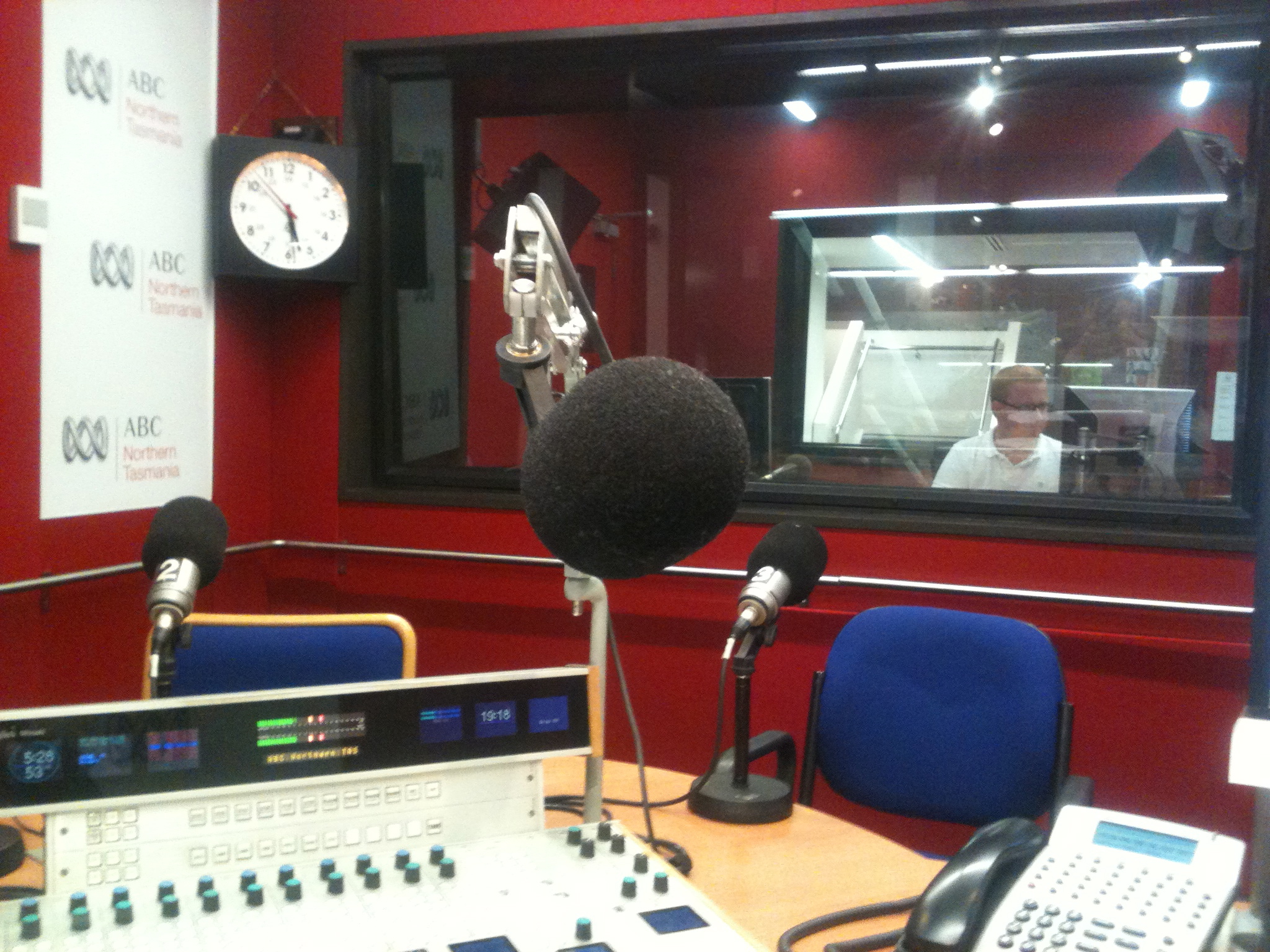
Every now and then I’m asked to fill in as a presenter or producer on ABC Local Radio. I get to talk to interesting people and hope to make their stories come alive for listeners who might even stop what they’re doing for a few minutes to hear something that makes their heart sing or brain churn. As a writer, my day job is to try and keep the world away while writing about it: a more internal world. But radio time is out there: it’s living in the kitchen, or the car, or on a computer, thriving on the magic of now and the language of the spoken voice rather than the written word. They’re different.
Last week, the spoken words of Geordie Williamson stopped my day, even though, at 730 in the morning, it was way too early for that. The new fiction editor of Island magazine was inspirational when I interviewed him for ABC Northern Tasmania Breakfast. He said he thought Richard Flanagan was destined to win the 2014 Miles Franklin Prize for his novel The Narrow Road to the Deep North, and that Amanda Lohrey is the best women fiction writer in Australia. Which means, simply put, that two of the best writers of fiction in the country are Tasmanian. Enough, perhaps, to inspire a whole new generation of writers, as well as those who struggle to get published. Anyone is able to submit their fiction to Geordie at Island magazine. And just listen how he wants to hear from you.
I flirt with every month but it is March I love. The Pipers River valley view is starting to green, summer laziness tires of itself, and the garden beckons to be nipped ‘n’ tucked up all over again, pert for winter. Suddenly you realise autumn’s circus has rolled into town, as the season’s traffic light starts to reverse from green through amber and red. The deciduous countryside reminds of England, France or Tuscany as much as Tasmania, but those who seek a native autumn will soon be rewarded by a special show. Certain things unique to Tasmania are also unique in the world. Like the leatherwood tree, the Tasmanian devil, and the migrating shearwater, the fagus – also known as deciduous beech – is Australia’s only cool-climate, winter-deciduous tree. You can see its startling colour in late April and May around Cradle Mountain and Mount Field. Scientists remind us that this small tenacious tree that thrives in alpine climes is as much a link to our ancient past as the solid rock that formed Gondawana. We islanders of the southern ocean are slow-lane learning to be most proud of what makes us different: turning the isolation of Bass Strait into a virtue. To lose its leaves is a tree’s defense against winter and the cold. And to stand and witness the changing beauty of the fagus is to know and feel virtue in adversity. Come, winter, bring it on! It’s what makes us truly Tasmanian – and the rest of Australia want to visit.
Lower Wilmot’s Don Dosser, one of the world’s greatest rhododendron breeders, featured in Country Style.
Unless you live in the island’s northwest, most Tasmanians would be hard pressed to name the exact location of Wilmot. Visitors taking an alternative route to Cradle Mountain may know that by the time they reach the tiny hamlet you’re well on the way to alpine country. Even so, unless you happen to be looking for it – like the bus-load of hard core gardeners from all over the world last week – or visiting the artisan cider cellar door on Back Road, you’re unlikely to stumble on the surprising beauty that is Lockington.
As you wind your way through bush on Back Road – not that much wider than a car – you come to a gully with a little bridge that crosses Braddon’s Creek. It’s easy to miss the remarkable surprise to the right. Wattles and blackberries hog the foreground, but behind them, on the side of a steep hillside, you’ll see an extravagance of conifers, and the impressionistic purple, red and green palette of a man known locally as “The Man of Maples”.
Twenty years ago, when Victorian nurseryman Don Dosser retired to live in Wilmot, he brought the stock from his nursery with him in two semi-trailers. It took 18 months to find his block of paradise, consigned to scrub by most locals because of the steep slope and its blanket cover of writhing wild blackberries, groves of blackwood and silver wattle and marauding ferns. “Back then I could only hear the waterfall, I couldn’t see it,” Don recalls.
What Don could see was the perfect place to create the garden of his dreams. Blessed with good soil, high rainfall and a cool climate, the 3.8 hectare block was set back from the road, ensuring his passion would not be interrupted.
He set about clearing 1.2 hectares, constructing an amphitheatre of terraced paths, and finding a home for his established trees, conifers, rhododendrons, and rare maples, chosen as small tree companions to filter the light rather than “throw a dead shade”. “I was 58 when I walked in the gate, and it was just a paddock full of blackberries,” Don says. “Jeez it was a mess. People said ‘You’re mad!’ I said no, I’m going to create a garden.”
Although Don might tell you he’s poorly educated (he left school at 13 to work in a joinery factory making doors and windows), Australia’s most prolific rhododendron breeder is more than a little bit clever. To date, Don has bred 148 rhododendrons that are registered by the Royal Horticultural Society in England, including his famous Lockington family. And, still, he points out, there are more in his garden to name.
“Everyone’s saying do another two to make it to 150, and I them tell I’ve been doing it for 44 years – I’m tired. You can’t just name them.” It’s understandable that he might be just a little bit sick of it. It takes at least eight years to grow a plant from seed to flower – time that no one much wants to commit to these days.
Don keeps records of all his hybrids in two thick photo albums that are kept on the kitchen table ready for visitors. He built the hexagonal-shaped house himself, “so you can look out over every aspect of the garden”. These are the views of a garden visionary who leads an otherwise solitary life. But as you turn the pages of his cherished red leather volumes you meet the many people in his life, gathered together as a much-loved family of flowers.
There are Uncle Arch and Pop Garrett (named after his uncle and grandfather); Peggy Charlotte (named after the lady Don once worked for who died of breast cancer), and the-raspberries-and-cream colours of Marie Day. “She’s a retired nurse who lives down the bottom of the hill,” says Don. “We had Xmas dinner together every year for 20 years, until last year when she went to visit family in Queensland.” There’s DoctorPeter Hewitt, the Launceston doctor who treated Don for throat cancer. And Johnny Mack. “He’s a truck driver”, says Don, though incongruously because the flower is very pink.
Don is most proud of his first rhododendron aptly named Lockington Pride. “I was real proud of that because I was only young and I bred a plant that I named that was in the books all over the world,” he says, the remembered excitement rising in his voice.
It was Don’s mother, a florist, who inspired his love of gardening. “She grew rhodies because they were out when other things weren’t, and she could use the flowers for wreaths,” says Don. He recalls taking her to a national flower show in the Dandenong Ranges where he met Australia’s then leading rhododendron breeder Karl van de Ven. “He bred one that year that was called Cup Day that came out on Melbourne Cup day. It interested me that a bloke bred a plant all on his own.”
Don went to work for Karl at his nursery in Olinda, in the Dandenong Ranges, were he learnt the art of propagating and grafting. Twenty years or so later, Don returned to the flower show with his own rhododendron. “It was Lockington Pride. And it won, so I thought I was on to something here!”
Don named his winning bloom after a Yorkshire English village, the home of his great grandparents who immigrated to Victoria in 1860. At the Emu Valley Rhododendron Gardens in nearby Burnie, there’s a three-metre tall specimen of Lockington Pride – the highlight of the collection that Don has donated.
Lockington may not be a fashionable garden, but gardeners from as far afield as Japan, China, Britain, Canada and Germany seek out Don Dosser on Wilmot’s Back Road. “They read books and hear what I’ve been doing and they know me before they meet me,” Don says. “I don’t look for any of it.”
Nearing 80, and too frail to garden much, Don is satisfied with his magnum opus – “Lockington New Dawn”.
“I class that as my best”, he says.
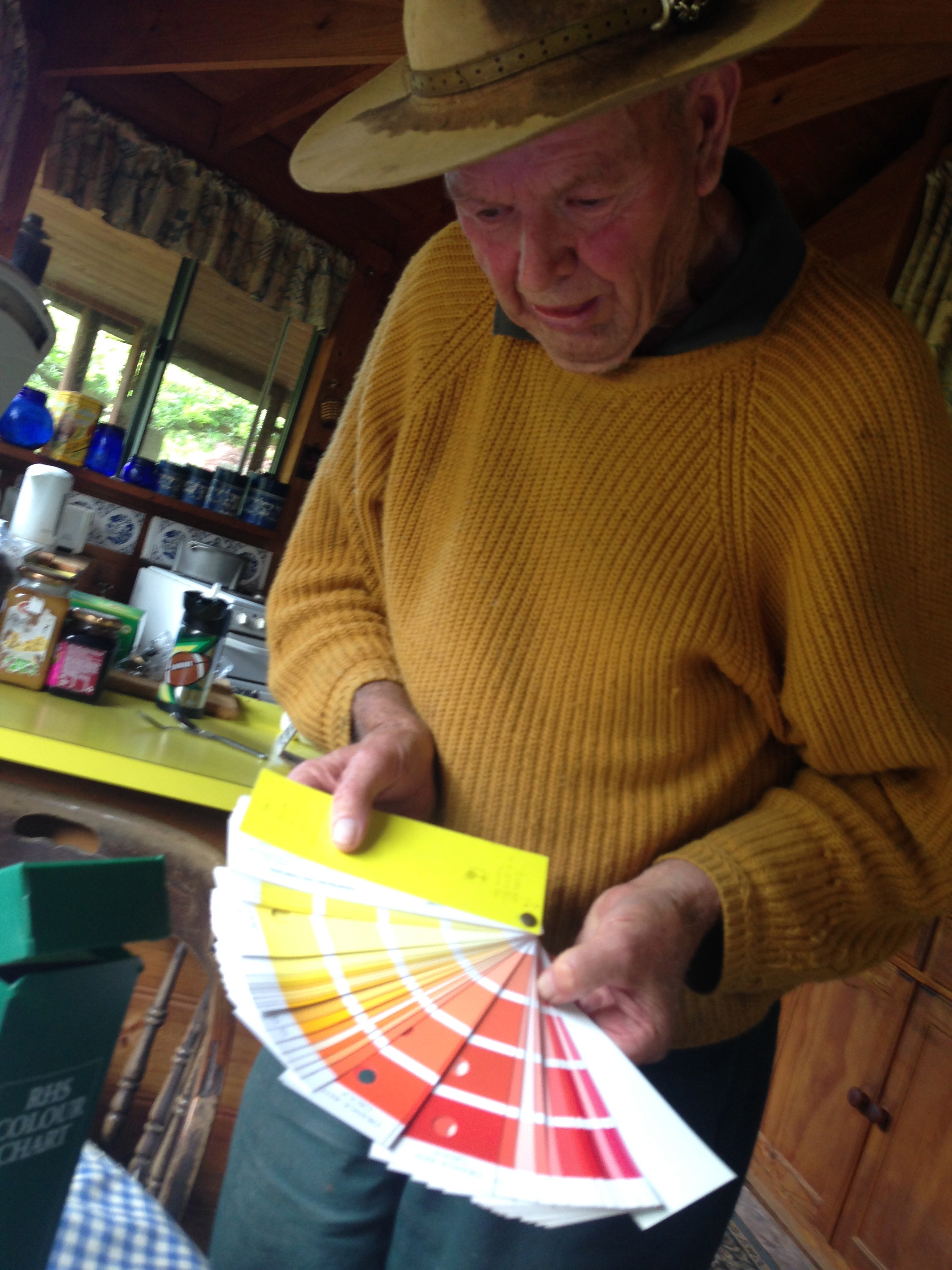
Rhododendron breeder Don Dosser with his RHS rhododendron colour chart
Published in Country Style, March 2014, the Tasmania issue
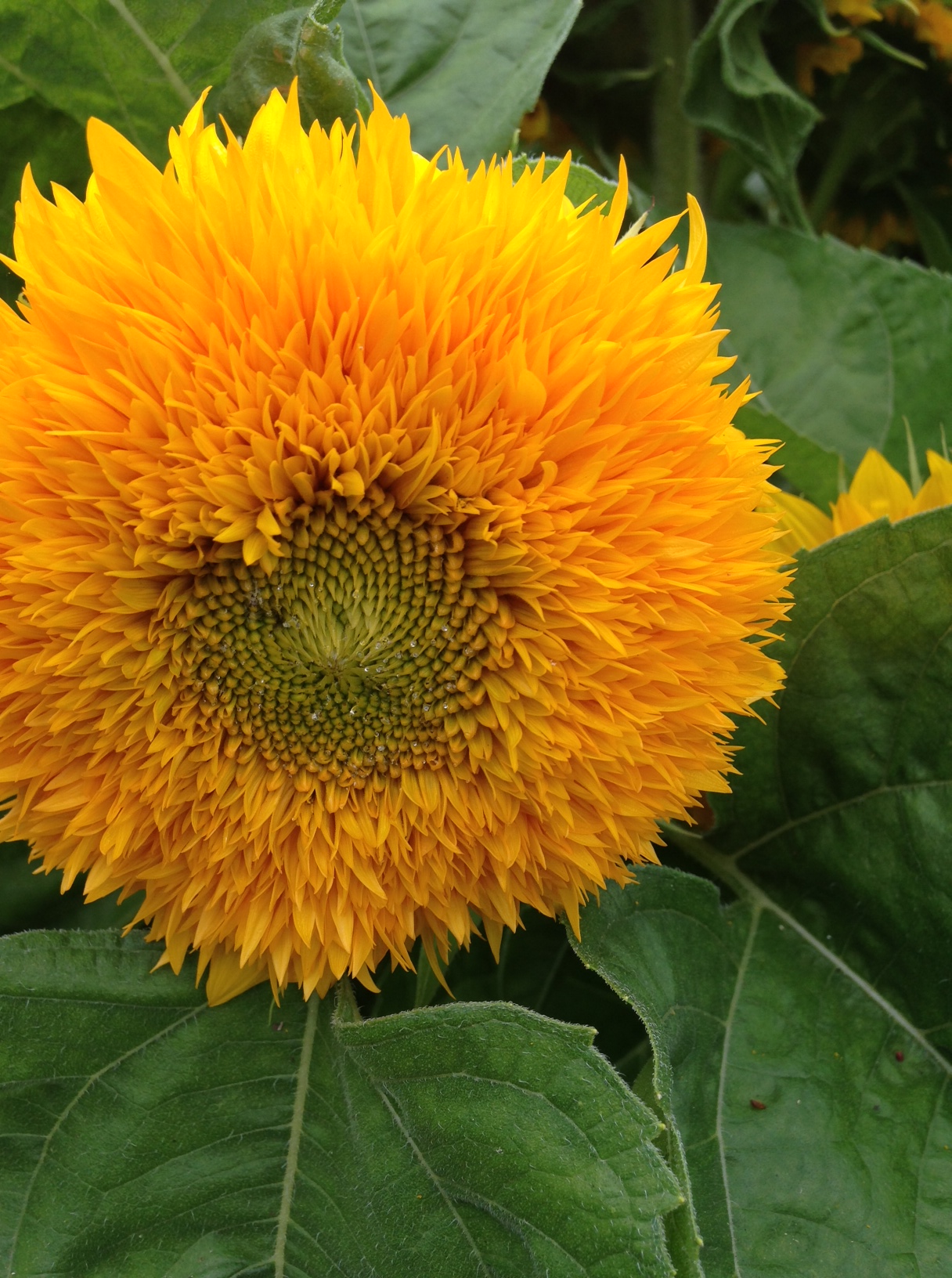
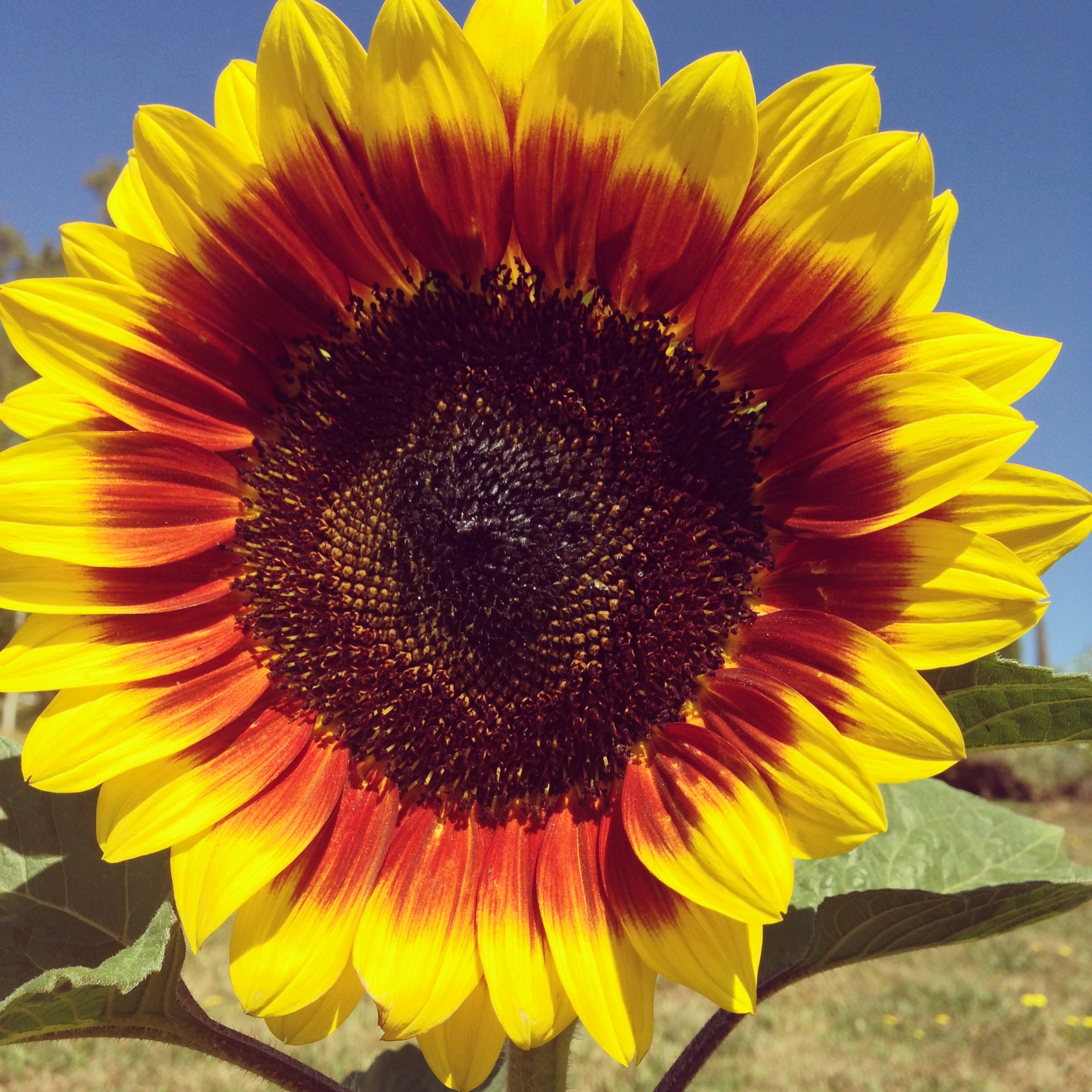
Sunflower in the herb garden, Royal Botanic Gardens, Sydney
Of all the crops harvest-ready across the Australian landscape now, sunflowers would have to be the most striking. At a time when the land is more sundried than kissed, the sunflower’s seeded face – destined for turning into oil for our kitchen tables – is improbably cheerful. While few of us would recognize a blurry paddock of barley or wheat as we travel by at 110 kph, sunflowers are crowd stoppers: the subject of important paintings. Growing up, I had a poster of Van Gogh’s “Sunflowers” Blu-tacked onto my bedroom wall. I loved its rampant colours and wilting blooms that struggled to escape from the vase, as if the artist had just stuffed them into the nearest vessel he could find. On a recent trip to the Van Gogh museum in Amsterdam, I watched as a small group of school children gathered around a version of the painting that was my poster. Despite my not understanding Dutch, their enthusiasm for this not very hip bunch of flowers was obvious as they gathered in a half-circle, gazing at the artist’s brushstrokes, firing competing questions at their guide. One reached out to touch the painting, quite involuntarily, and you could catch his own gasp as he realized just in time what he had done. When the artist was working on his sunflowers 125 years ago he did so “with the enthusiasm of a man from Marseilles eating bouillabaisse”, or so he wrote to his friend Gaugin.
There is something about sunflowers. I used to sell potted sunflowers that I’d grown from seed for $2 a pot at Lilydale market. ChiIdren were my biggest customers and I like to think they wanted to nurture their pot so they could hold the sun in their hands. In the museum shop, “Sunflowers” was reproduced onto a dazzling array of domestic products from serviettes to canned puzzles. But I think the way to see them is in real life: inside the day, as you watch their improbably large heads follow the sun.
Great journeys are often defined by the nature of their infrastructure: think of US Route 66, the Nullabor Crossing, the Trans-Siberian Railway or the Great Wall of China. But there are smaller journeys – without the badge – that nourish the soul. Little trips with minimal fuss where people are as important as the view.
The coastal road from Ulverstone to Penguin on Tasmania’s Central Coast is one of those that starts and ends with bookend towns where thoughts exchanged across a counter can give a slant on life that comforts or enriches – a gift from a stranger who wants to send you on your way with a cheerful thought. You won’t find this nourishment by taking the highway.
The dual carriageway from east to west speeds traffic away from the scenic route – how many of Australia’s coastal country towns could say the same? What’s missed is precious: facts you might read in local history books and certain offbeat tourist brochures. For example, that the foreshore rocks form part of the Penguin Geological Monument and are recognised by the Geological Society of Australia; that a silver mine once operated here; and that the fairy penguins that Penguin takes its name from can be spotted at sunset at the Lillico Beach Conservation Area (carpark for 20 spaces provided, as well as a guide, in summer).
But the 12 kilometres of road that wind around this mineral foreshore has other attributes: a strip of railway laid in 1901 that hugs the beach and parallels the road where daisy-filled gardens are mysteriously maintained on land, owned by whom? Ask a local and they will tell you the flowering shrubs are maintained by volunteers because it’s always been that way. The gardens seem to spill outside of householder’s private front fences, onto the nature strip and across the road to the other side, where white sands and rocky outcrops greet whatever succeeds in surviving the separation by tarmac.
And on the other side, away from the beaches, look up into the most verdant paddocks Tasmania has to offer – chocolate fields, broccoli, carrot and cabbage pastures, with infinity horizons broken only by tractors. You will find your own places to stop and be, or just potter under the speed limit knowing that the people who need to speed will have known not to take this route.
The added joy of the scenic route from Ulverstone to Penguin is its inhabitants – if the route were a pearl necklace, the people are its pearls, and not just any old pearl. There’s a certain type of woman doing quite well, thank you, they’re mums (single and otherwise) who run their own funky, niche businesses so they can bring up their children in a relaxed place and run their own lives.
At Dragonfly in Ulverstone, Jill may greet you from among the cornucopia of gifts and homewares, with Katie Perry-style hot pink hair. We’ve never met before, but it doesn’t stop her from sharing this thought: “You’ve gotta have fun! There’s no point in living if you can’t get away with dyeing your hair pink!” I decide on an old fashioned knitted tea cosy, and Jill explains that they’re made by her mum using old knitting patterns, and that, just lately, she hasn’t been able to keep up with the demand.
Just down the road at The Blue Barn collectables store, Valerie tissue-wraps a pair of cream Wedgewood teacups I spotted amongst her wonderful collection of antiques. As she does this, she tells me how she came to be here in Ulverstone, after escaping “a dreadful life experience”. Now, two years on, she couldn’t be happier and she tells all her customers if something goes bad in your life, it means something good is about to happen.
“We’re on Tassie time,” says Penelope, who moved from the Blue Mountains where she sold produce to gourmet food stores, and now heads up Produce to the People, a community project which gathers excess produce from backyard gardens in Tassie’s northwest, redistributing it to people who need it. In her trips collecting produce from drop off points along the coast, Penelope sees what she describes as “the comraderie of awesome women”. “Often they’re single mums feeding from the energy they are creating for themselves,” says Penelope, “and that particular energy is passion.”
One of her drop off points is Renaessance Café and Gallery in the main street of Penguin, opened a year ago by Tania, a former hairdresser. “I’ve always wanted a little boutique café,” she explains, “and nothing too big, so that I could run it myself. I walked past this shop window one day – I think it had been empty for years – and could visualize it here: a hole in the wall café with a view of the sea. I’d just finished my business diploma and thought: This is it. Here I go!” A year on, and people drive for miles for her locally made salt and caramel slices.
If you want, you can stretch your journey further along the coast, and it’s especially good to do when the tulips are in bloom at Table Cape near Wynyard, where Lisa Walker is celebrating her third year at Bruce’s Café and her philosophy of ‘grow it, cook it, eat it’. The former actor and drama teacher says she put herself through five years of university by working as a waiter in cafes. “It was those sideline skills that I’m now using for a livelihood I love,” she says. “I had a list of things I wanted to do, like move to the coast, and run my own business. It doesn’t matter if it’s a success or not because I’ve achieved my ‘I wonder if…’ Now, I no longer have to wonder.”


 Hilary Burden