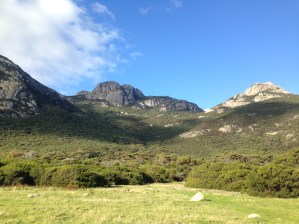
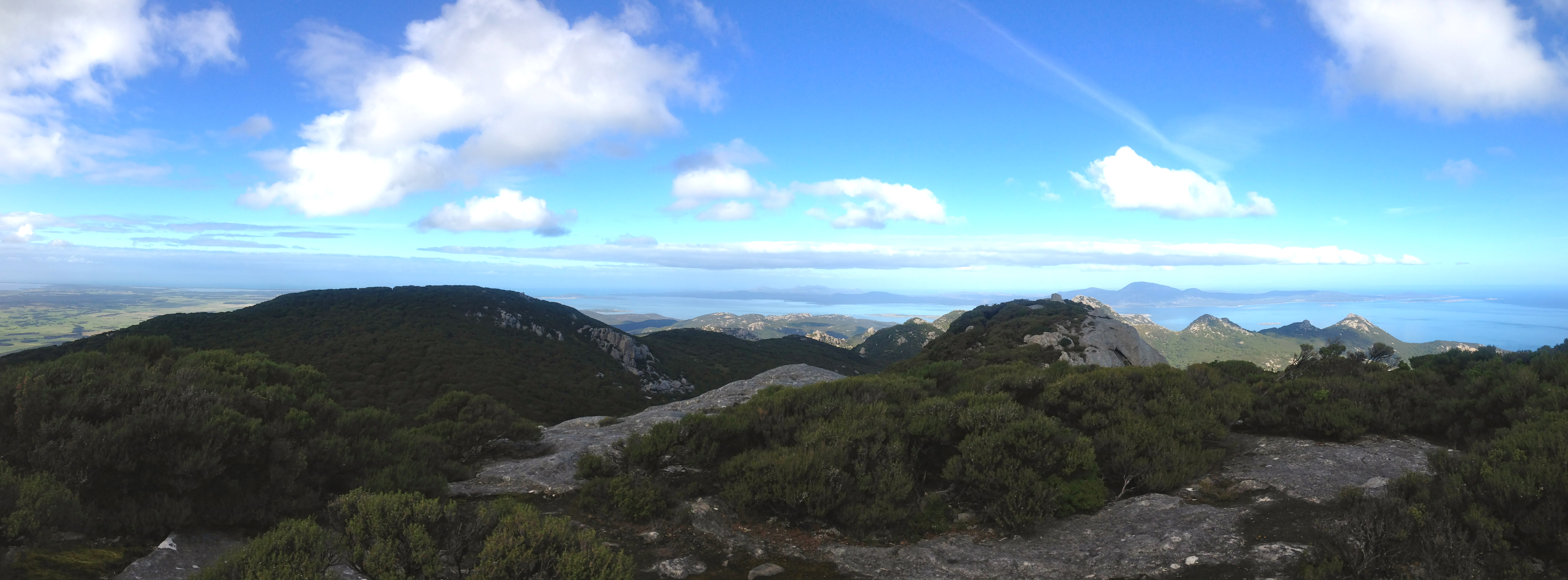
Why do people climb mountains? Because mountains are ancient and rise above it all, putting more everyday matters where they belong. To simply claim the summit is missing the point. “It’s not the mountain we conquer but ourselves.” Edmund Hillary once said. I was reminded of this on the final ascent up a rocky gully on top of the Strzelecki Ranges, Flinders Island’s highest granite peaks, named after the Polish explorer who first climbed them. At 756m and with a 360-degree view, for this solo climber it was almost too high to cope with. Vertigo set in and I reverted to clambering on all fours, telling myself not to look down so I could make the final ten metres; that I would forever regret not reaching the top. I’m not sure if I would have regretted it because the walk up from sea level had been fulfilling in itself. But after hauling my body over the final boulder, the view from on top was both dizzying and electrifying. To make it to that summit and see where you’ve come from is like drawing the moon nearer to you. You’ve earned everything you feel right now. Climb a mountain this month and appreciate something bigger than yourself. If not a mountain, a tall hill will also do it.
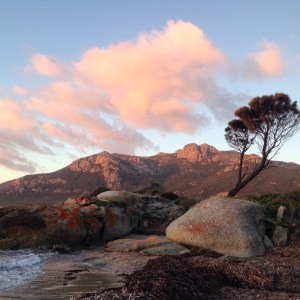
On Flinders Island, ocean lies at the end of every gravel road. Usually, there’s a picnic table nearby, with sharp views of ancient granite peaks, softer coves or a graceful azure coastline where you can sit and consider things like: shells you just collected; which path to walk (bush, boulders or sandy beach); how, finally, the kids are playing outside their bedrooms; the crayfish being barbecued for lunch… nothing about tomorrow, it can wait. Anyway, there might be storms, then, and plans will have to change.
Flinders Island is the place to come to if you want to stop the world and have an adventure and rest (yes, the two can go hand in hand). To put it in perspective, the distance north to south is roughly the same as Sydney to Gosford, or Melbourne to Geelong. But uninterrupted spaces, and the island’s location in Bass Strait, make you feel like you’re really going places – one km feels like 10km. With a population of a small village (around 900), in an area roughly the size of Hong Kong, it’s possible to feel like you’ve been washed up on a place owned by nature – where every day is like the world has just begun. Local writer Fran Bryson tells her visitors that, for islanders, “a crowded beach is one with someone else’s footprints on it”. The presence of people, or even signs of their presence, can somehow shrink a place.
It’s an adventure just getting here. Flying from Launceston (or Essendon) in a silver twin-engine turbo prop aircraft, you might fancy yourself as Angelina or Brad, hopping aboard your own private jet. “Welcome to Flinders Island: Remote and Rugged”. It’s the first sign you see on disembarking – words passengers use themselves viewing the islands from the air. A boat trip from Bridport or Welshpool is another option, arriving like the sealer-Straitsmen of old. Travel times depend on both weather and the effect of the tides on one of the world’s wilder stretches of water that kept Tasmanian Aborigines separated as hunter-gatherers for 10,000 years.
A visit to the Furneaux Museum, one of Australia’s best small museums, is a must, as well as historic Wybalenna Chapel and cemetery at nearby Settlement Point. A haunting reminder of Australia’s recent past, Wybalenna’s graveyard contains unmarked Aboriginal graves, along with headstones of the first European settlers, and a plaque to commemorate Mannalargenna, the north-east Tasmanian nation’s 19th-century ancestor. The few surviving Aborigines from the Tasmanian mainland were finally exiled here in the 1830s to be ‘civilised and Christianised’; many of them suffered disease and death before the remaining 47 were moved back to Tasmania.
Today Aborigines live on both Flinders and Cape Barren, and are largely descended from north-east nation women taken to live on the islands by European men seeking to make livelihoods outside the colonial regime. Cape Barren Island, which had been established as an Aboriginal Reserve in 1881, was formally handed over to the Aboriginal community in 2005. Cultural knowledge continues to be passed on by elders who can trace their ancestry to Mannalargenna through his daughters.
Flinders is home to farmers and fishermen, artists and writers, and services and small businesses supporting the needs of both the local community and tourists. From the two main towns of Whitemark and Lady Barron, you can arrange or access most things necessary for enjoying Flinders life. You can experience a taste of exactly what’s on offer by following local Sammi Gowthorp who blogs at www.islandlifestyle.com.au and posts stunning images on her Instagram account (@FlindersLife).
Sammi and her husband AK left Melbourne with their two young children two years ago and now live at Lady Barron. “We lived by the freeway in Melbourne,” says AK, “so we know what getting woken up by traffic in the morning is like.” “Now we wake up to the sound of birdsong,” laughs Sammi.
With two well-stocked rural supermarkets, as well as E.M. Bowman’s family store (est 1921), and Roberts the local stock agent, if Islanders can’t get what they need they either grow it, make it themselves, or just make do without.
“I think Flinders Islanders do really well,” says Whitemark chef and caterer Anne-Marie Wilkins from Annie’s Kitchen, whose pies sell in Gippsland, too. “Our beef, our lamb and our seafood, as well as our home grown veggies, afford us the luxury of eating like kings and queens – daily!”
Which means, while the island has just a handful of restaurants, pubs and cafes, visitors who want to camp, picnic, or be catered for are well served by locals who make it their business to provide for every appetite. And also why, even when you’ve reached the end of the road, from Trousers Point to North End River, and from Killiecrankie to Cameron’s Inlet, it seems there is a picnic table at every perfect cove and beach. No neon signs or fancy schmanzy add-ons. The landscape is what speaks (“Freycinet on steroids” is how one local described it), requiring little fanfare.
For those who view the pastimes of beachcombing, rock-hopping, wildlife watching, or picnicking as more for the feint-hearted, there are challenging bushwalks that include a climb to the top of Mt Strzelecki. Rated ‘Hard’ in the guidebooks because it’s all of 756m high, the 5-hour return National Park walk involves a final scrabble up boulders to the peak, and affords such an all-round view of Tasmania and beyond it makes you want to hold on to the nearest rock or fellow climber. Views from Walkers Lookout or Vinegar Hill are a little less adventurous and may be just as pleasing on a clear day.
Anyone interested in observing Tasmanian flora close up is in for a treat on Flinders; there are many endemic and endangered species here, as well as plant and birdlife unique to the Furneaux Group of islands. The Whitemark library is well-stocked with books on the subject (including One Hundred Islands: the flora of the Outer Furneaux), as is Bowman’s bookshop, and Flinders Council’s Visitor Information Centre. Former island resident and late historian Stephen Murray-Smith wrote eloquently of Bass Strait as “Australia’s last frontier”. For him it was “an area of priceless significance for all time” with the capacity to become “one of the world’s notable protected areas”.
When you visit, you will see what he means, and understand why it’s up to all of us to help protect it.
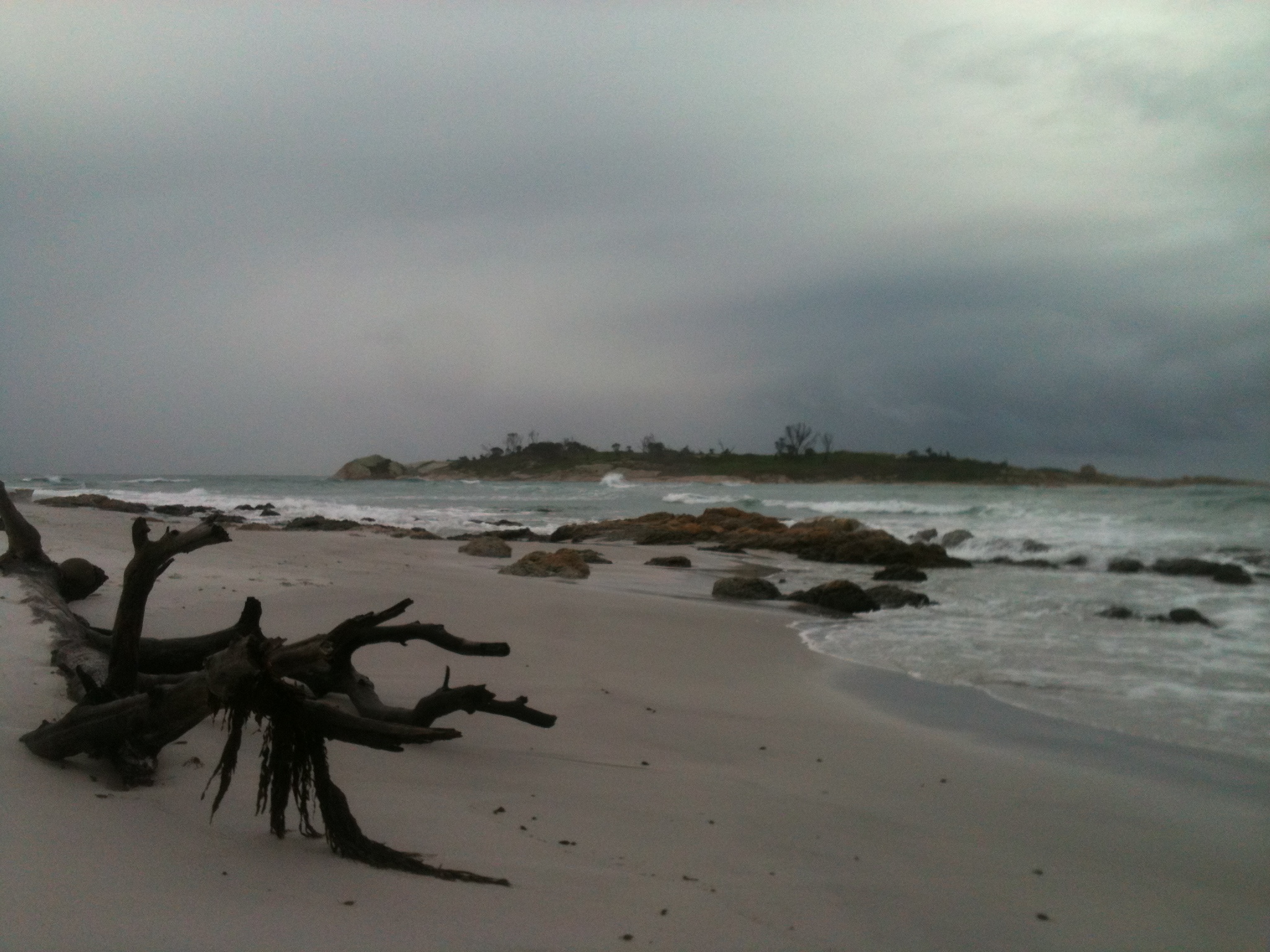
Think of the Australian beach. Do you see the white-sand smiles of a sunburnt country? The kingfisher blue of Bondi or Burleigh Heads; of Wineglass Bay, Cottlesloe or Noosa…? Aussie beaches are iconic because of how they’re used in summer: past times often immortalized by artists like Charles Meere’s Australian Beach Pattern, 1940 or Max Dupain’s The Sunbaker. But Australia is girt by sea all year round and if you haven’t yet embraced the winter beach…go now. Don’t just leave it to the diehard surfer who togs up in rubber regardless of the temperature. You will find a different you on a beach in winter, under a bruised sky, in winds you must punch headfirst into, against grains of sand that scratch and stick. There’s nothing placid about a winter beach after a storm and everything in nature is bigger than you: from foaming white waves that deafen to pungent mounds of seaweed dumped on the last tide. You can’t be lazy on a winter beach: a swim is not inevitable and spreading out a towel to lie on out of the question. Instead, a winter beach calls you to action like a parade ground sergeant major. Boots, parka, and a rucksack for finds of flotsam and jetsam replace the flimsier requirements of a humid day. And when you get home you know you can re-enter your comfort zone with a hot shower, hot chocolate, or hot pot. Everything hot under the sun, in fact, because you’ve earned it.
As so many old wives’ tales contain a grain of truth it’s baffling why they are so ridiculed. There is much to learn from those who have observed life from the passenger seat over a lifetime and who may never have courted fame or glory. An old wife’s tale may not be science, but as a guidepost to life, it is knowledge that nurtures and binds us, that is carried on the breeze, that slow-drips through families from parent to child, like a recipe or a game. Often an old wives’ tale is the useful advice we recall when illness or an emergency arises. Ten years ago, when I moved back to rural Tasmania from London in early summer, I remember being told to be aware of snakes and how they appeared in months that contained the letter ‘r’. It seemed an odd piece of advice – yet there is truth to it. It’s one way of describing the spring and summer months when the copperhead, tiger and whip snakes in this southern patch are awake and looking for sun and water, and you need to be told ‘Be careful you don’t tread on a snake’. Now it is May and the ‘r’ months are behind us, although this is no excuse for us to hibernate, too. These are the months to bushwalk boldly; to sign up to National Parks pass; to open your lungs to the smell of a forest, coast, or cliff-top. To stand in a rainforest, reach a lookout, climb a pinnacle, admire a waterfall from underneath, or on top. To get outside and be in the world, not following or ‘liking’ it, but living it.
All that remains of the Nuns’ House quince after January’s big wind turned most into windfall
Mists of amethyst and leaves of tangerine, russet and flame-gold: you’d best put off the jewellers until you’ve visited a park for inspiration. Enjoying the poetry of April colour is just the half of it; the other is harvest. An autumn table may be stacked with pumpkins and pears, hazelnuts and walnuts, pomegranates and persimmon, sweet chestnuts, golden nuggets and – in a world of its own – the quince. Lumpy, dusty, blotchy and high maintenance (you can’t eat it straight from the tree), the old-fashioned quince will have you reaching for a recipe. Yotam Ottolenghi’s lamb-stuffed quince with pomegranate and coriander is tempting but tricky; another Londoner, Tessa Kiros, offers the Greek treat of baked quinces with brown sugar, cinnamon and walnuts. I’m happiest, though, with the way I ate my first quince, using a recipe given to me by my neighbour Suzanne, along with a bag of quinces from her orchard. Cover peeled and quartered fruit with water and sugar (1 cup sugar to 2 cups liquid), add a vanilla bean and lemon juice, and bake without stirring in a covered casserole at 150 degrees for 4 hours until quince is deep red. The kitchen will smell of quinces for days if you leave them to bake, slowly, like this. It’s hard to see the point of quince jelly when you’re served a bowl of soft quinces dribbled with double cream. And now that I’ve planted my own tree, I appreciate how the golden fruit hangs on while the leaves drop, making the season seem less melancholy.



 Hilary Burden