

Subscribe to continue reading
Subscribe to get access to the rest of this post and other subscriber-only content.
Author. Writer. Journalist.
Subscribe to get access to the rest of this post and other subscriber-only content.
O may my hearts truth still be sung…
It’s a line from ‘Poem in October’ by Dylan Thomas.
Written on his 30th birthday in Laugharne, the fishing village where he lived the last years of his life.
Dylan Thomas was the first writer and poet I studied in English Literature; his play, Under Milk Wood, the very first text.
I wonder what he would have made of this digital world when his gut-poetry came from the earth he walked, the air he breathed, the golden light that spun the path ahead, the sea mist that spritzed his face.
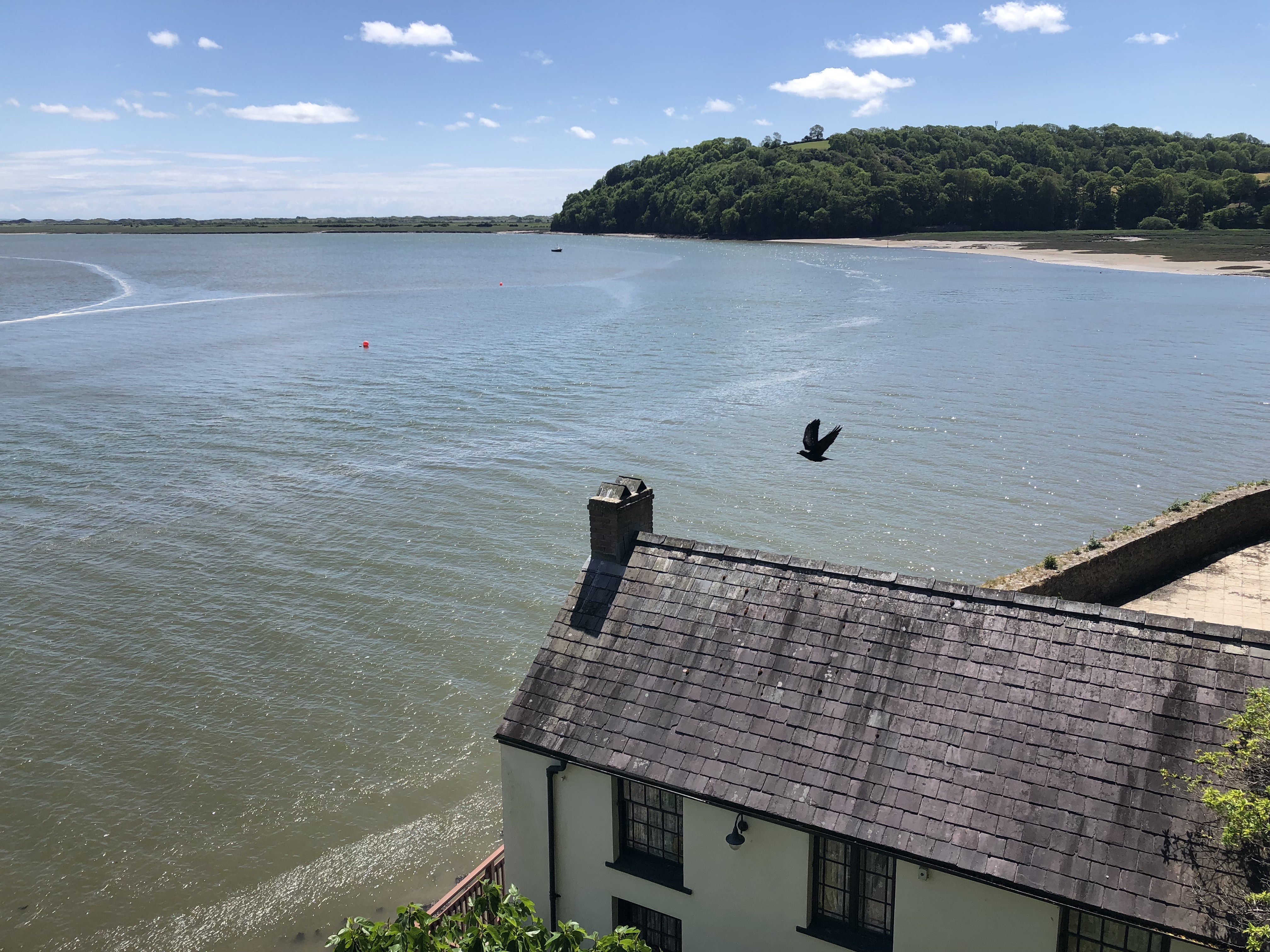
So I visited (thanks Marty) in a different season, in May’s sun and mizzle. And walked New Walk. And hung under the wood and peered through the window of his writing shed, perched like a nest over the Tay. And became the tourist in the boathouse that was his home. Where tea and scones are sold though no copies of Under Milk Wood, sorry, you need to go to the big town for that – “At the moment”.
You can walk the coastal cliff walk where the poem was written, signposted “Dylan Thomas’ Birthday Walk”, on through Salt House Farm. Benches sing out his lines overlooking riverbed and sea.
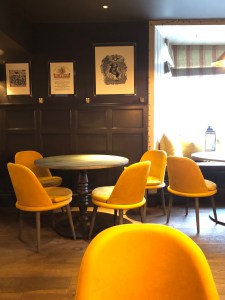
I thought about Mrs Ogmore Pritchard, polishing her potatoes, as I sat in the bay window of Browns Hotel watching the good townsfolk and tourists of Laugharne pass by. Where I tasted Welsh Laverbread for the first time. Seaweed pulp. It comes in a tin. Tasted like oysters and olives. Actually I liked it. And then I wrote this poem.
O may my hearts truth still be sung
At Penderyn.
Watching from breakfast’s window seat
Out there where the weather has turned around.
Just yesterday on the coast track
Sun as yellow as these cushions.
Plumped up chests, arched in warmth, rested on benches,
Gazed out like the view over river, wood and sea,
Tuned to the breeze thick with ocean and meadow dust.
Tea cups rattle at your boathouse now
Scones on the make.
No one seems to care where the tide is
In or out.
One boat stranded on the sands
Waits, leaning like a good drunk
Craving to be righted by the moon.
Today is misty on your birthday walk
Under ageing ash and farmed views of the brown owl castle.
On the Salt House Farm track
Elderflowers and foxgloves pimped like the Sun King,
High mauve and dotty cream,
Heave their invisible scents along this path
Where you the poet walked at 30.
Maybe at 40 and 50 too?
Not so sunny now on the hill’s shoulder.
Past my bay window seat at Browns Hotel
Heads are bowed down under umbrellas.
The garbage truck has been and gone in steam from the chemist’s chimney.
“Morning, you okay then?”
Yes, fine thanks. Laverbread and eggs please.
At Penderyn.
©️Hilary Burden 2019



It’s been so long since I’ve written anything on my own website, the template I used has become obsolete. So I’ve upgraded to a new version, Libre 2. Which is kind of apt. I’m embracing a new version of me, too. Free from my beautiful house, which now has new, happy owners. Free from Tasmania, an island I will always think of as home. And free from my Antipodean friends and family, who, of course, I love and miss.
After 14 years I decided, like a bird, to uproot myself and travel to the northern summer. You could say I have truly learned to let go. My travels are revolving around catching up with old friends and family in London, and seeing things that inspire heart and mind (wild flowers in a footpath; exhibitions and museums that excite; libraries and bookshops that welcome writers).
Australia still calls. My latest story, on the restoration of landscape artist John Glover’s home at Patterdale, Tasmania, is published in the Australian Financial Review‘s Life & Leisure section, and online, this weekend (April 10, 2019).
I wrote a story on Sarah and Andrew Ryan’s Hillandale garden in the Central Western Tablelands of NSW for a Special Edition of Gardens Illustrated magazine, with stunning photographs by Claire Takacs, author of Dreamscapes and Australian Dreamscapes, published by Hardie Grant. And, we team up again in Gardens Illustrated July 2019, with another amazing Antipodean garden.


After finally completing the first draft of my second book, I am currently looking for a publisher. One who might get my slightly whimsical, spiritual take on learning to live in tune with a sense of place – truly, madly, deeply.
I’m not sure how many of you are left as ‘followers’ or even if these mutterings will be interesting to anyone other than me. That is the nature of the beast, and how we steer our way between vanity and relevance. While people say personal websites are less in vogue these days, I plan to practise journal writing here. Knowing there are readers will help me sharpen a sense of interest.
Then, when the northern summer is over, I’ll make a new nest – one that hasn’t found me yet.
I’ll leave you with a quote that made my heart sing in an exhibition at Burgh House, Hampstead, featuring stories about famous and artistic women who live or once lived in the London village. It’s a wonderful venue, full of inspiring people and a beautiful place to write. This, from Katherine Mansfield’s Journal, 10 October 1922.
“By health I mean the power to live a full, adult, living, breathing life in close contact with what I love. All that we mean when we speak of the external world. A want to enter into it, to be part of it, to live in it, to learn from it, to lose all that is superficial and acquired in me and to become a conscious, direct human being. I want, by understanding myself, to understand others, I want to be all that I am capable of becoming.”
And cheers to all that!

Inside Franklin’s art deco Palais Theatre south of Hobart, sprigs of fresh wattle blossom get tucked behind ears, teenagers wear rose pink ballgowns making breezes as they walk, muttonbird canapés served in little bamboo rowboats are laid at each table setting, and young boys wearing trouser braces and new boots play hide ‘n seek in the buffet queue around dad’s legs.
The CEO of the Southeast Tasmanian Aboriginal Corporation (SETAC) is wearing a black velvet evening gown with silver sequin cuffs, accessorised with a traditional Aboriginal shell necklace of toothies and maireneer shells, and the Huon Valley Council Commissioner is ballroom-dancing in a red silk taffeta gown.
The Dress Code on the invitation read: “Something that makes you feel beautiful.”
The NAIDOC Ball held every year since 1972, has long been staged in Tasmania by the Tasmanian Aboriginal Corporation (TAC). This year, on the same night, there was a second ball, held by SETAC for the first time in its 26-year history.
The Huon and Channel areas have particular pride in two strong Aboriginal women with a significant, yet painful, presence in the Tasmanian story – Fanny Cochrane Smith and Truganini. On July 13, 2018, they were brought to life through a celebration in contemporary song and dance.
The Melukerdee Aboriginal community, whose Country includes Fanny Cochrane Smith’s former home and church in Nicholls Rivulet and Truganini’s home and resting place on Bruny Island, invited friends and family for an evening of cultural activities, presentations and awards, MC’d by singer-songwriter Dewayne Everettsmith.
“It couldn’t have happened without this year’s NAIDOC theme,” SETAC’s CEO Tracey Dillon told the gathering. “’Because of her, we can’ has been the best theme ever. Tonight you’ll get the full understanding of that.”
Above the stage a large painting of female elders by Aboriginal artist Leonie Honeychurch gave the national theme strong visual presence. And the scene was set with a moving Welcome to Country song performed by the Melukerdee Aboriginal community, written by Toni Murray. Girls and women of all ages danced as swans and sang a greeting from Country in melodic Melukerdee language.

“As a Melukerdee woman, Toni wants to revive her language, and reclaim her culture and her Country,” says Ms Dillon, a Badtjala woman from Fraser Island who has lived in Tasmania for 15 years, and married Rodney Dillon on Bruny Island.
While the TAC promotes the palawa kani language, Bradley Strong from SETAC explains it is not one his people use. “We have different language, different stories, different tools,” he says. “Behind the celebration there is something important to focus on. We want to open up and be inclusive – invite people from outside our Aboriginal community for cultural exchange.”
It has taken more than a quarter of a century to reach this point in the evolution of contemporary Southeast Tasmanian Aboriginal people. Cultural differences between Tasmania’s seven Aboriginal groups are increasingly being expressed through the Tasmanian Regional Aboriginal Communities Alliance (TRACA), officially recognised last year by the Tasmanian government in a signed Statement of Intent. Tasmanian Aboriginal communities are now on a path to reviving between 8 and 13 languages around Tasmania.
Rodney Dillon, TRACA’s co-chair and national NAIDOC Person of the Year in 2005, told the NAIDOC Ball in Franklin that SETAC was first established with the publication of ‘We Were Not Here’ in 1992. The book by author Robyn Friend contained oral historical accounts of Aboriginal families in the Huon region.
“The aim of that project, and starting SETAC, was to talk about where we came from and to celebrate really strong families,” says Mr Dillon. “Because people weren’t recognised we weren’t allowed to practise our own culture. It’s a shame. Not only that our ancestors in the ground weren’t there, and we had to fight for repatriation of their remains, but that we couldn’t catch our fish, we couldn’t catch our muttonbird, or be having our swan eggs…
“For years I felt we were really struggling because we were Aboriginal on the one hand but, on the other, we didn’t have any rights. Now, we’re not where we want to be, but we’re on the right track. We’re singing songs as a family, as a group, just as they would have done for thousands of generations.”
For many present at SETAC’s NAIDOC Ball, cultural connections with the past were honored, shared and spoken in public for the first time. Voices were female, gentle, some emotional, as many of Fanny Cochrane Smith’s descendants were able to sing Country to life in language, just as Fanny would have done through her performances of Aboriginal songs and dances. (In 1899 and 1903 Fanny recorded songs on wax cylinders. Now held in the Tasmanian Museum and Art Gallery, they are the only recordings ever made of Tasmanian Aboriginal song and speech.)
Inside the ballroom, pinned onto noticeboards, were messages from girls from the Huon and Channel schools married with names and photographs of elders past and present. It was a powerful space for Aboriginal girls and women to shine a light on their strengths.
Among many varied cultural performances, Bronwyn Dillon read a poem she had written for Fanny Cochrane Smith, evoking her ancestor’s presence in the smell of bush flowers, in the firelight, in the salt water:
“I know when you are there
I feel your presence, I feel your warmth
It’s almost as though our hearts are beating at the same time”
Tracey Dillon called for a minute’s silence “for Ma Dillon and all those women who went before us”. She also acknowledged other Aboriginal people finally receiving recognition for their contributions, including Aboriginal educator and northeast elder Aunty Patsy Cameron and Karly Warner, a lawyer with the national Aboriginal and Torres Strait Islander Legal Service who flew in from Adelaide for the ball.
Due to illness, a message recorded by Aunty Shirley, SETAC Aboriginal Elder of the Year, was played to the gathering. She encouraged elders to “teach our language and culture, to respect all people, and above all believe in ourselves, be proud of who you are and follow your dreams”.
The Palais Theatre lights were dimmed when Tracey Dillon introduced one of the many highlights of the night, inspired by a recent community cultural tour. Over two days, Rodney Dillon had led SETAC staff on visits to important cultural sites where their people had lived for tens of thousands of years – from the Picton River in the Wilderness World Heritage Area to Black Lagoon on Bruny Island – with the aim of rebuilding culture and strengthening community wellbeing.
“We know that Truganini was with us then,” Ms Dillon told the gathering. “We walked her lands, we walked near her lake, near her home, we sat where she probably ate, where she fished and swam. Tonight we have something special for you to remember that day, because our women want to reclaim their culture.”
Debbie Cowen presented “Black Lagoon”, a moving, spiritual tribute to one particular place that stood out for her on that visit to Bruny Island in June.
“When I arrived at this place the hairs on my arm stood up,” Ms Cowen told the gathering. “A sea eagle flew over. I imagined he was watching us. We sang our song in our language at the lagoon, and on the path home – over and over again. It was the most emotional cultural journey I think I’ve travelled.”
For Mr Dillon, it is everything to take young people on cultural journeys, see the empowerment it gives them, to observe and sit with the looks on their faces. “We didn’t have that before,” he said, “and now we’ve got that.”
Aunty Patsy Cameron made the ten-hour return drive from her grandfather Mannalargenna’s country at Tebrakunna. “It was really important to be present at the inaugural SETAC ball,” she said. “It was a balance of cultural activity, role models and champions in community – all proud women speaking their language, and such a beautiful expression of culture”.
Speaking before the presentations, Huon Valley Council Commissioner Adriana Taylor told Tracey Dillon, “her black sister”, that she had been inspired by Aunty Ida West, a great advocate for reconciliation.
“Ida West asked us to walk together,” said Ms Taylor. “It isn’t about them and us, it isn’t about black and white. We can’t forget the past – we do have to fix those things – but we have to walk together to do that and Ida West believed that very strongly. Because of her I learnt how to live with you and how to appreciate Aboriginal culture. So, because of her, I can.”
On being awarded SETAC’s NAIDOC 2018 Lifetime Achievement Award, Rodney Dillon gave way to the next generation.
“To be a strong organisation, it’s got to be run by the young people today,” he told the gathering. “It’s no longer for our old people to be running. I’m happy to take people to places, on trips to our strong sites. When we go to these sites, it’s like our people have just left.
“I’m not going to achieve all the things in my lifetime that I want to do but I feel pretty safe that some of these young people who are here tonight will achieve them in their lifetime. That makes me feel we’ve left it in good hands.”
Presentations were also made to Tess Strong for Community Achievement and Bradley Thompson who received the Youth Award. SETAC’s Commitment and Dedication Award (from the staff) went to Rodney and Tracey Dillon.

In the year themed “Because of her, we can”, SETAC’s NAIDOC Aboriginal female award for 2018 was presented to chair of the cultural committee, Toni Murray.
“I stand here a very proud Aboriginal woman,” she told the gathering who applauded wildly as she fought back tears.

For more information contact SETAC, or visit The Living History Museum of Aboriginal Cultural Heritage & Gardens of the South East Nation in Nicholls Rivulet.
First published in the fortnightly national indigenous newspaper Koori Mail.
The opening of a permanent gallery dedicated to 40,000 years of Aboriginal culture marks a turning point in creative collaboration – but tensions remain as communities find their way forward.
One of the most striking features of The First Tasmanians: Our Story exhibition at Launceston’s Queen Victoria Museum and Art Gallery, is a wall map of Tassie that has never been seen before. It depicts Tasmanian Aboriginal clans, and it is mesmerising. Shades of ochre, as opposed to lines, represent porous boundaries belonging to 57 known nations: the Toogee around Macquarie Harbour, Hobart’s Mouheneenner peoples, and the Leterremairrener in the north. In a side key, swan rookeries are identified, along with hunting and marine harvesting grounds.
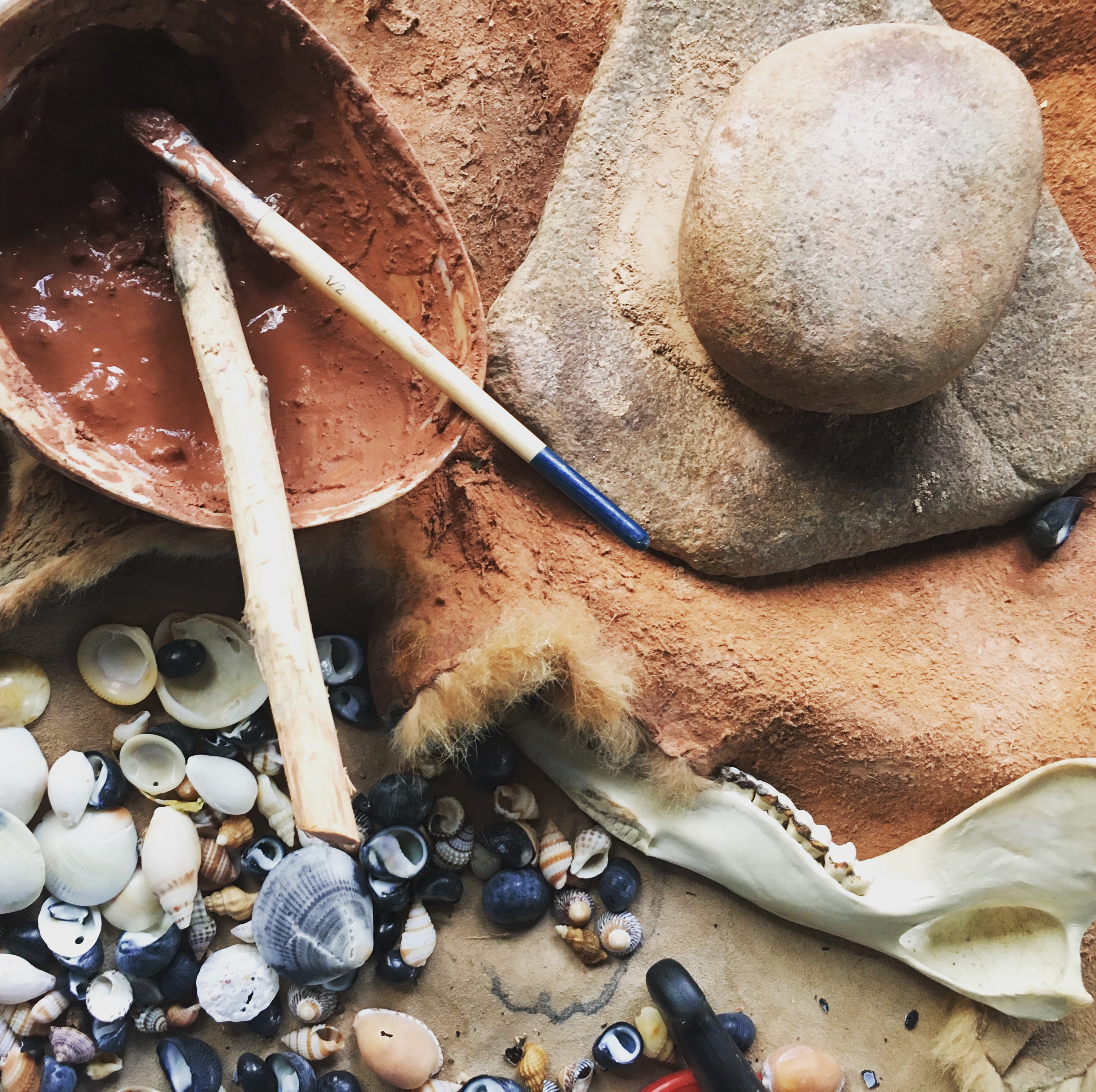
Nearby is a black crow shell necklace, uncovered only recently in the permanent exhibition’s curatorial journey. It is thought to have belonged to Trucanini, for a long time wrongly considered the last full-blood speaker of a Tasmanian language. A massive projection of stars shows how the southern sky looked 50,000 years ago, long before the land bridge formed and Aboriginal people arrived in Tasmania. And an epic warrener shell necklace made by artist Julie Gough hangs on the wall – you have to take a step back to view it.
Until now, such aspects of the First Peoples’ culture have rarely been shared or acknowledged outside Aboriginal academic circles. A crack curatorial team headed by Jon Addison and David Maynard has plundered the extensive writings of former QVMAG director N.J.B. (Brian) Plomley, author of the seminal Friendly Mission: The Tasmanian Journals and Papers of George Augustus Robinson, 1829-1834. On his death, Plomley donated his collection of books, maps and papers from the 1950s to the ‘80s to the museum.
Instead of a primary focus on The Black War – a 30-year period of intensive conflict between European colonisers and Aboriginal people culminating in Robinson’s exile of 135 Aborigines at Wybalenna on Flinders Island – the spotlight is on families and their way of life. Who knew so many clans thrived over many thousands of years in every part of Tasmania, each with its own architecture, names, technology, cultural practices and language?
Project manager and consultant curator Greg Lehman says the clan map is just one of the “wow factors” of the new gallery. He should know. Lehman has spent 15 years working with two galleries as a member of the Tasmanian Museum and Art Gallery’s Aboriginal Advisory Council and the National Museum of Australia. He is also consulting to Mona as it develops the concept for a proposed Truth and Reconciliation Art Park as the centrepiece of Hobart’s Macquarie Point site redevelopment.
Lehman says the aim of The First Tasmanians is to jolt people out of their comfort zone – to see there were Tasmanian families living here 40,000 years ago. He says the team didn’t want a comfortable, old-fashioned museum of European record based just on archaeologist and anthropologist research. “There has to be another narrative,” he says.
The first permanent Aboriginal exhibition at QVMAG had its beginnings in the ’90s with a small installation at the top of the stairs. Lehman calls it “a little presence” – put together by North-East elder Patsy Cameron, a Coastal Plains descendant of North-East warrior Mannalargenna.
“We were so happy to have an expression of our culture in a corner of Royal Park,” says Dr Cameron, who is widely known as Aunty Patsy. “We were once placed alongside the museum’s curiosities. Look at us now – it is an amazing legacy.”
Just a stone’s throw away, in Cataract Gorge, Aboriginal clans once met and gathered for ceremony, hunting and trade. From the roof of the gallery at Royal Park, it is tempting to imagine pillars of white smoke from clan fires drifting up through the magnificent dolerite cleft.
It’s early June and the wind is chilling at Scottsdale’s Northeast Park when I catch up with Aunty Patsy on Reconciliation Day. About 25 people have gathered for a cultural event put on by Dorset Council. Former and current mayors and deputy mayors are present, along with local Aboriginal families and friends, teaching string-making and shaping music sticks from dogwood, later to be clapped together in a brief dance. The Yarning Circle (a loose gathering formed around these activities) is designed to help connect communities through cultural conversations, promoting a show of respect in the face of differing views.
Aunty Patsy is down to give a talk on the history of Tasmanian Aboriginal culture, “recognising the struggle but celebrating the strength in community for keeping it alive and thriving”. She is disappointed so few have turned up in the bitter cold, but she’s pleased to see the council supporting a Reconciliation Day event.
Along with cultural practitioner Dave Mangenner Gough from the Tiagarra Aboriginal Cultural Centre at Devonport, Aunty Patsy is co-chair of QVMAG’s Aboriginal Reference Group, formed before the exhibition was proposed. Also in the group are artists Vicki West and Lola Greeno, and Arts Tasmania program officer Denise Robertson.
Members of the Aboriginal Elders Council and Clyde Mansell from the Aboriginal Land Council of Tasmania (established to manage the state’s indigenous land) contributed cultural voices and objects to the gallery, including necklaces, baskets and kelp water carriers made by elders. Launceston organisations, groups and key individuals, including the Tasmanian Aboriginal Corporation (TAC), were invited to information sessions. TAC staff or representatives did not attend.
Lehman says the desire was “to complement not duplicate” what TMAG does (there’s little reference here, for example, to contact history). A Mona-style phone app has been developed for teachers and students, and 3D gaming technology has been used to demonstrate sea level rising (you get to see the Bassian land bridge rise and fall).
“This is not 200 years. This is deep time. Time that is almost impossible to imagine,” Lehman says. “It’s 10 times older than the pyramids – what does that even mean? The stars aren’t where they should be. Tasmania as an island doesn’t exist. The sea level is 150m lower, not 2cm higher. The coastline was way out to the continental shelf. We are challenging your point of view, trying to make the mind-boggling accessible.”
I am taken on a tour of the gallery by its director Richard Mulvaney. Upstairs in the main gallery, we visit one of QVMAG’s most treasured possessions, Aborigines of Tasmania 1859. The famous painting by Australian colonial artist Robert Dowling is based on a series of watercolour drawings made in the early 1830s by convict artist Thomas Bock, whose portrait of young Aboriginal girl Mathinna, adopted and abandoned by the then Governor of Tasmania, is held by TMAG.
Dowling made his impressive painting in London and presented it to the citizens of Launceston to be exhibited in the Mechanics’ Institute in 1860. It was later transferred to QVMAG for its opening in 1891, where it has remained ever since – “virtually in the very same place”, Mulvaney says.
The painting, along with other works by John Glover and Bock, shows Tasmanian Aboriginal people with a sense of majesty and nobility, although the artists’ humanity came far too late to save them. Very little has since evolved in the positive depiction of Tasmanian Aboriginal people. Lehman says Tasmania has been slow off the mark compared with the rest of Australia to celebrate the culture of its First Peoples, “not least because Tasmania has an uneasy relationship with its past: a history of genocide”. “You could say there’s been an attitude of ‘least said, soonest mended’, or ‘let sleeping dogs lie’, or ‘too hard, let’s not go there’,” he says.
But there is something in the air in Tasmania with institutions factoring in the First Peoples in a different way, perhaps led by an increasing number of visitors looking for our “points of difference”. Take, for example, Federal Hotel’s new MACq 01 Hotel telling a story through objects of the Mouheneenner people who “fished and forged dreams in the Derwent shallows”. Guides or “master storytellers” take guests on the 114 Doors Storytelling Tour through “a patchwork of stories and artefacts that punctuate our hallways”.
Then there’s Mona’s Truth and Reconciliation Art Park proposal, with its recognition of the 30-year war between British invaders and Aboriginal people and the celebration of 40,000 years of continuous culture; and a new not-for-profit body, the Reconciliation Council of Tasmania, set to launch on August 9 (UN Day of the World’s Indigenous Peoples), bringing the state in line with the rest of the country.
Reconciliation Australia’s Bill Lawson (the only Tasmanian board member, and founder and past chair of the Beacon Foundation) says RCT aims to improve relations between the state’s Aboriginal and non-Aboriginal people, and ease tensions within the indigenous community. He acknowledges there’s work to be done in helping the Aboriginal communities of Tasmania come together and hopes the RCT will play a key role in that.
Institutions are responding to a long-held desire of visitors, as well as non-Aboriginal Tasmanians, to connect with a deeper sense of place and history. It is a different approach to, say, the TAC’s “Aboriginal Land” sign at Risdon Cove or the permission required to visit on Aboriginal land at Preminghana on the West Coast.
“Let’s go there” has been the approach with The First Tasmanians, but via a different perspective – “a commitment to inclusivity and valuing diversity”, Lehman says, “rather than trying to emphasise one privileged, European perspective, which means we’re also open to what people want to say”.
The approach includes newly commissioned works by renowned artists Gough, Greeno and West, who are all part of the National Indigenous Artists Triennial at Canberra’s National Gallery of Australia. Visitors are guided to view First Tasmanians’ history not through a colonial filter but through a rich, deep, human past.
Mulvaney, whose late father was a pre-historian renowned as the father of archaeology in Australia, says the new gallery has national significance, describing it as “very valuable”. Some artefacts from the museum’s collection are only now seeing the light of day.
Last Mannalargenna Day – an annual celebration held in December on the anniversary of North East warrior Mannalargenna’s death in 1835 – QVMAG curator Addison and designer Andrew Johnson returned three hunting sticks from the museum’s collection to Country. They wore protective gloves to hold the precious artefacts, thought to have belonged to Mannalargenna, that now form part of The First Tasmanians. “One member of the Aboriginal community saw them and cried,” Addison says, “so moved were they to see them on Country again.” Many Aboriginal people in Tasmania trace their lineage back to Mannalargenna.
QVMAG guides have been tutored in cultural awareness. “It’s been a process of empowering the institution, its staff and curators,” Lehman says. “Creative collaboration is one of the great things that has developed through this partnership – to be able to think together and uncover things.”
You can understand why, at a time like this, with such positive outcomes driven by passion, research, lived experience and collaborative expertise, raising the subject of rifts between Aboriginal people has the potency of a wrecking ball. But rifts are in the air this NAIDOC Week.
Across Australia they come with a name: “lateral violence” is being openly addressed. In a recent article in Guardian Australia, “Too white, too black, or not black enough?”, @IndigenousX host Shannan Dodson describes lateral violence as “a festering sore of colonisation that continues to tear our communities apart”. Dodson writes how “anger and frustration about feeling powerless can lead to violence – not ‘vertically’ towards the colonisers responsible for the oppression but ‘laterally’ towards their own community”.
In Tasmania, this rift can be seen playing out between the TAC (formed in Launceston in 1971 to provide services to Aboriginal people, with offices in Launceston, Hobart and Burnie) and TRACA (Tasmanian Regional Aboriginal Communities Alliance), formed in 2015, representing seven groups in regions around the state, including Flinders Island, Circular Head and Bruny Island. Rodney Dillon is TRACA chair, while Aunty Patsy, who turned 70 this year, is vice-chair. Aunty Patsy also received an honorary doctorate from the University of Tasmania this year, and was last month awarded an Order of Australia for her services to indigenous education.
In a Mercury Talking Point last year, Aunty Patsy and Dillon explained the group’s formation as a response to “the continued mantra that the TAC was the only voice to speak for all Tasmanian Aboriginal people”, and to “better respond to the Hodgman Government’s policy to reset relationships with Aboriginal people”. While they acknowledge the TAC, they say it does not speak for them and say the TAC continues to meet and make decisions (especially about heritage, language and constitutional recognition) that appear to exclude them.
For example, palawa kani, a revived form of the original Tasmanian Aboriginal languages, was first developed as a project in 1999 in conjunction with the TAC. In this NAIDOC Week, themed “Our Languages Matter”, the TAC portrays it as the Aboriginal language. Schools are following their program.
In contrast, TRACA views palawa kani as “a creole language” and says there are other avenues to naming, including the works of Plomley (for example, A Word-List of The Tasmanian Aboriginal Languages).
In response, the State Government has halted the dual naming process until names can be agreed between everyone. At the time of writing, however, the Office of Aboriginal Affairs has not caught up with the re-setting agenda. Its website still endorses an Aboriginal and dual naming policy implemented in accordance with the TAC.
There are other tensions, too. Recent satirical article Tracking My Way by playwright Nathan Maynard, “published” in The Census Black and posted on his Facebook page, depicts him dressed in costume as a character he calls “Aunty Judy McConnell”. Some who see the creation as a vicious parody of real Aboriginal Tasmanians are distressed by apparent allusions to themselves in the spoof feature.
Maynard, a descendant of Mannalargenna, wrote his own story about his family’s muttonbirding culture on Big Dog Island in the play The Season, which played at the Sydney Festival and Ten Days on the Island. Along with Rob Braslin, he recently returned from a five-day workshop for new comedy writers organised by producers from the ABC’s Black Comedy. He described the Aunty Judy spoof as “my first piece as a journalist”, posting it on his Facebook page, hoping it would “get a spot on the community pinboard”. Among the comments were “too genuine” and “the next thing Hodgman’ll get her on the TRACA thingy”.
Maynard says the article was intended as satirical and was timed around the 2016 Census figures, which he says showed “a lot of people are claiming to be Aboriginal with no evidence of ancestry”. He wrote it for the community – his Tasmanian Aboriginal community – “the one that comes from the Bass Strait islands and the old fellas who came off the Reserve on Cape Barren Island”.
While recognising the Aboriginality of Dillon, Aunty Patsy and others, he says many are “imposters who wake up black one week” and that “true Aboriginals fight for land and rights”.
On the eve of NAIDOC Week, the TAC called for a “forensic audit” of the number of people claiming Aboriginality in the 2016 Census. The rise from 19,000 to 23,000, they say, doesn’t add up.
Aunty Patsy, whose mother was born at Cape Barren Island, believes Maynard is mocking aspects of her cultural practice. “A small group of people is inflicting lateral violence on Facebook and in public, while many others are showcasing our wonderful culture and telling our stories to the world,” she says. “For Nathan Maynard, it’s about credibility for himself as an individual. There is not one voice – we are many voices.”
Some elders who have kept cultural practices alive felt shamed by the satire, regarding it as an abusive form of attack. Aboriginal family violence worker Fiona Hamilton says “elder abuse is rampant in our communities”.
“And we have very high levels of family violence and a lot of under-reporting,” she says, describing Maynard’s posting as “an extremely complex little meme” and a “prime example of lateral violence and cyber-bullying”. “If a non-Aboriginal person wrote that, especially at a time when we’re struggling with power and the abuse of power, all hell would break loose.”
Can the positive depiction of The First Tasmanians go any way towards healing hostilities? Or are great tensions a sign of the extraordinary challenge of sustaining a living, evolving culture? How do you sustain a culture simply by trying to preserve it?
Singer-songwriter Dewayne Everettsmith, from mina-nina, an indigenous-owned company specialising in indigenous tourism and events in Tasmania, is unashamedly commercial in his approach. He sees the future in making their culture professional.
“We want to return our community to culture by encouraging them to learn skills and work in professionalised jobs, competing on a contemporary level in a high-quality, demanding industry,” he says. “We believe that competing culturally, not politically, will provide the best outcome for our people.”
In The First Tasmanians, Gough’s warrener necklace is suspended on a driftwood hook. Describing it as “a wayfinder”, it is the artist’s way of amplifying her culture. The making and wearing of shell necklaces by Aboriginal women is a traditional cultural activity that has survived 1800 years. It is certain to survive satire, too. The clan map of Tasmania is a powerful representation of diverse communities looking after their kin, their local heritage and their language. Can The First Tasmanians help provide a track back to that?
“We are a broad church,” Lehman says.
I ask how he would say that in Aboriginal language.
“Waranta [all of us] mapali [mob],” he says. “That’s the palawa kani spelling. Plomley records several other spellings.”
Though Mulvaney expects some fallout, he is undaunted by the gallery’s task. “It is absolutely vital we tell the Tasmanian Aboriginal story,” he says. “And there’s more to tell. But not by us – as in QVMAG staff. We are guided by the Aboriginal Reference Group. They’ve guided us through what could have been a murky and unhappy process. They’ve instructed, informed and we’ve responded. We’ve given it a very good shot. It is their story. And in telling their story through the gallery and our public programs, it becomes all our story.”
The First Tasmanians – Queen Victoria Museum and Art Gallery, 2 Wellington St, Launceston. Entry is free. The gallery is open daily, from 10am-4pm.
Published in TasWeekend, July 8, 2017
 Hilary Burden